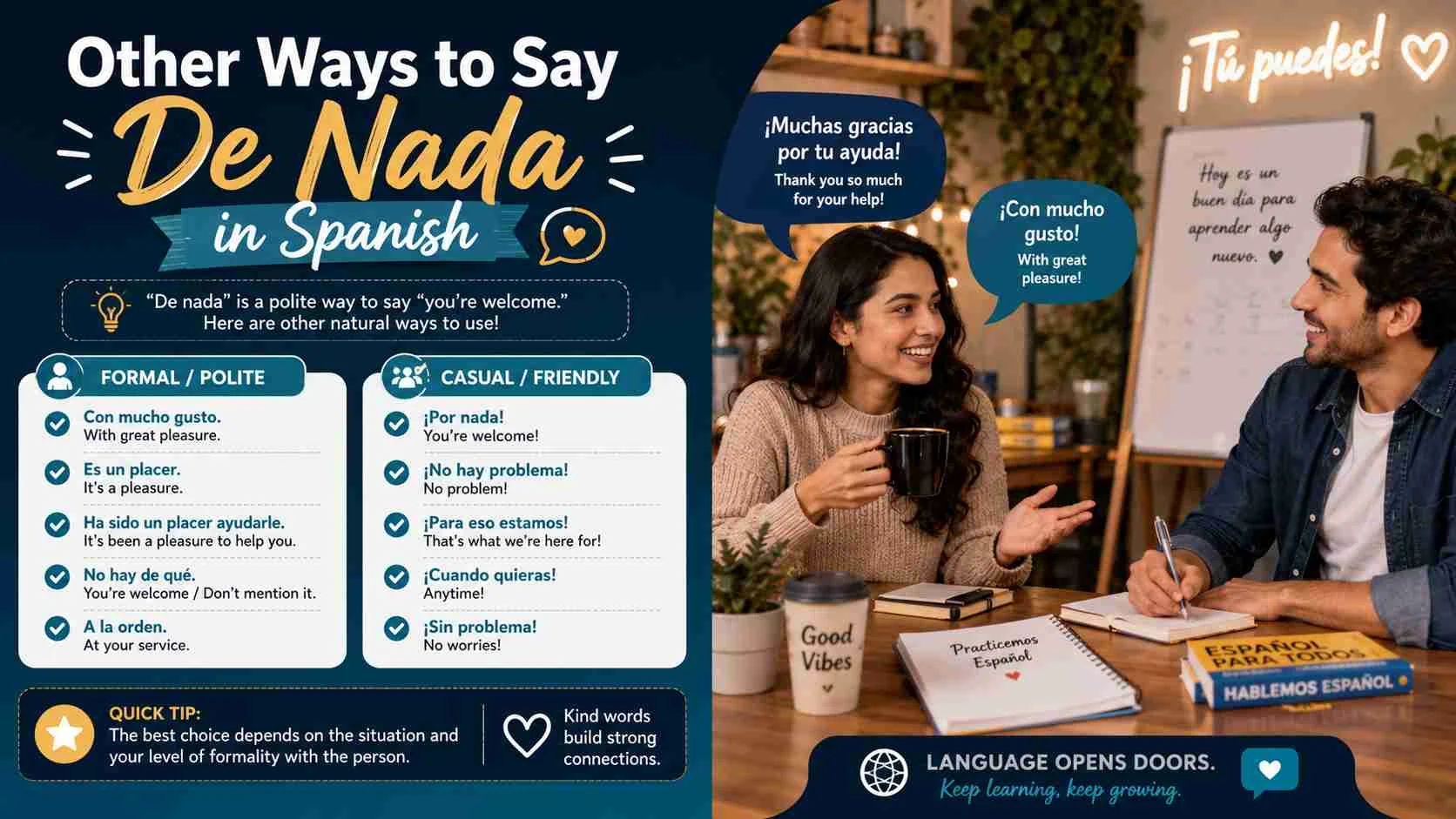
If you want alternatives to “de nada” in Spanish, some of the most common options include con gusto, no hay problema, por nada, no fue nada and a la orden. These expressions help you sound more natural, polite and fluent in both casual and professional conversations.
The phrase “de nada” is one of the first Spanish expressions learners discover. It is commonly used to respond to “gracias” and simply means “you’re welcome.”
Although “de nada” is correct and widely understood, native speakers often use many other expressions depending on tone, formality, and situation. Learning these alternatives to other ways to say de nada in Spanish can make your conversations sound smoother and more natural.
Understanding different responses also improves fluency and helps you express excitement in English and Spanish conversations more confidently in social, academic, and professional settings.
“Using the right response instantly makes your Spanish sound more natural and culturally fluent.”
Formal Alternatives to “De Nada”
Common Formal Responses
- Con mucho gusto
- Es un placer
- Para servirle
- No tiene nada que agradecer
Pro Tip
Use formal alternatives when speaking with clients, elders, customers, or in workplace communication. Tone matters as much as vocabulary.
Casual Alternatives
Friendly Everyday Expressions
- No hay problema
- Claro
- No fue nada
- Por nada
Pro Tip
Casual phrases are ideal for friends, classmates, and relaxed conversations. Avoid overly formal language in friendly settings.
“Native-level fluency comes from choosing the right tone, not just the right words.”
Professional Alternatives
Workplace-Friendly Options
- Encantado de ayudar
- Fue un placer ayudarle
- Estoy para ayudar
- Con gusto
Pro Tip
Professional reaction phrases should sound polite, calm, and respectful without becoming too emotional or overly casual.
Informal Expressions
Relaxed Conversational Phrases
- Dale
- Tranquilo
- Todo bien
- Estamos bien
Pro Tip
Informal expressions in English and Spanish often depend heavily on region and culture. Listen carefully to native speakers.
Common Mistakes Section
1. Using “de nada” in extremely formal situations
- Incorrect: “De nada, señor director.”
- Better: “Con mucho gusto.”
2. Using slang with strangers
- Incorrect: “Dale.”
- Better: “No hay problema.”
3. Translating English too directly
- Incorrect: “No mention it.”
- Better: “No fue nada.”
4. Using casual phrases in business emails
- Incorrect: “Todo bien.”
- Better: “Fue un placer ayudarle.”
5. Repeating the same response every time
- Incorrect: Always saying “de nada”
- Better: Mix expressions naturally depending on context.
“Small wording changes can make your Spanish sound far more professional.”
What Does “De Nada” Mean?
“De nada” literally translates to “of nothing” and is commonly used to mean “you’re welcome.”
It is a polite response after someone says “gracias.” Grammatically, it functions as a short conversational phrase rather than a complete sentence.
Example Sentence
- “Gracias por tu ayuda.”
- “De nada.”
When to Use “De Nada”
Common Contexts
- Responding to thanks
- Friendly conversations
- Customer service
- Casual daily interactions
- Spoken conversations
- Informal writing
Spoken vs Written
- More common in spoken Spanish
- Acceptable in casual written messages
Formal vs Informal
- Polite ✔️
- Mostly informal or neutral ✔️
- Not highly professional ❌
Is It Professional or Polite to Say “De Nada”?
“De nada” is polite and completely acceptable in daily conversation. However, it may sound too basic or informal in highly professional situations.
Business Example
- Client: “Gracias por la información.”
- Response: “Con gusto. Estoy para ayudar.”
Professional Evaluation
- Polite? ✔️ Yes
- Professional? ❌ No (in most cases)
“Professional Spanish often requires warmer and more polished responses than simply saying ‘de nada.’”
Pros and Cons of Using “De Nada”
Pros
- Simple and natural
- Friendly tone
- Common usage
- Easy to understand
Cons
- Too informal for work
- Overused
- Limited emotional range
- Not suitable for formal writing
Other Ways to Say “De Nada” in Spanish With Examples
These alternatives will help you sound more fluent, confident, and natural in different situations.
Use them according to tone, context, and audience to express excitement in English, appreciation, politeness, or professionalism.
1. Phrase | Con gusto
- Meaning: Happily or with pleasure.
- Explanation: A polite and professional alternative.
- Example Sentence: “Con gusto le ayudaré con el informe.”
- Best Use: Professional help
- Worst Use: Heavy slang
- Tone: Polite, warm, professional
- Context Variability:
- Casual: “Con gusto.”
- Professional: “Con gusto le apoyaré.”
- Spoken: Common in customer service
2. Phrase | No hay problema
- Meaning: It’s not a problem.
- Explanation: Common casual response.
- Example Sentence: “No hay problema, puedo hacerlo.”
- Best Use: Everyday talk
- Worst Use: Formal letters
- Tone: Relaxed, friendly, casual
- Context Variability:
- Casual: Very common
- Professional: Sometimes acceptable
- Spoken: Frequently used
3. Phrase | Por nada
- Meaning: It was nothing.
- Explanation: Short and natural response.
- Example Sentence: “Por nada, me alegra ayudarte.”
- Best Use: Friendly chats
- Worst Use: Official meetings
- Tone: Simple, warm, casual
- Context Variability:
- Casual: Very natural
- Professional: Less common
- Spoken: Everyday use
4. Phrase | No fue nada
- Meaning: It was nothing.
- Explanation: Humble and polite expression.
- Example Sentence: “No fue nada, no te preocupes.”
- Best Use: Small favors
- Worst Use: Formal business
- Tone: Modest, kind, friendly
- Context Variability:
- Casual: Excellent
- Professional: Limited
- Spoken: Very common
5. Phrase | A la orden
- Meaning: At your service.
- Explanation: Popular in customer service.
- Example Sentence: “A la orden para cualquier consulta.”
- Best Use: Customer service
- Worst Use: Friends only
- Tone: Respectful, professional, polite
- Context Variability:
- Casual: Rare
- Professional: Excellent
- Spoken: Regional usage
6. Phrase | Con mucho gusto
- Meaning: With great pleasure.
- Explanation: More formal version of “con gusto.”
- Example Sentence: “Con mucho gusto le atenderé.”
- Best Use: Formal service
- Worst Use: Teen slang
- Tone: Formal, elegant, respectful
- Context Variability:
- Casual: Less common
- Professional: Excellent
- Spoken: Formal situations
7. Phrase | Es un placer
- Meaning: It’s a pleasure.
- Explanation: Professional and polished phrase.
- Example Sentence: “Es un placer trabajar con usted.”
- Best Use: Business settings
- Worst Use: Casual jokes
- Tone: Professional, warm, formal
- Context Variability:
- Casual: Rare
- Professional: Strong choice
- Spoken: Formal interactions
8. Phrase | Para servirle
- Meaning: Here to serve you.
- Explanation: Respectful customer-service phrase.
- Example Sentence: “Para servirle siempre.”
- Best Use: Hospitality
- Worst Use: Informal friends
- Tone: Respectful, formal, service-oriented
- Context Variability:
- Casual: Rare
- Professional: Common
- Spoken: Polite service speech
9. Phrase | Claro
- Meaning: Of course.
- Explanation: Quick casual response.
- Example Sentence: “Claro, no hay problema.”
- Best Use: Friendly help
- Worst Use: Formal documents
- Tone: Casual, relaxed, easygoing
- Context Variability:
- Casual: Very common
- Professional: Limited
- Spoken: Frequent
10. Phrase | Encantado de ayudar
- Meaning: Happy to help.
- Explanation: Friendly professional response.
- Example Sentence: “Encantado de ayudar con el proyecto.”
- Best Use: Workplace communication
- Worst Use: Sarcastic contexts
- Tone: Professional, warm, helpful
- Context Variability:
- Casual: Possible
- Professional: Excellent
- Spoken: Common professionally
11. Phrase | Fue un placer ayudarle
- Meaning: It was a pleasure helping you.
- Explanation: Formal and respectful.
- Example Sentence: “Fue un placer ayudarle hoy.”
- Best Use: Client interactions
- Worst Use: Quick texting
- Tone: Formal, polished, respectful
- Context Variability:
- Casual: Uncommon
- Professional: Excellent
- Spoken: Formal speech
12. Phrase | Estoy para ayudar
- Meaning: I’m here to help.
- Explanation: Supportive professional phrase.
- Example Sentence: “Estoy para ayudar en lo que necesite.”
- Best Use: Support roles
- Worst Use: Casual memes
- Tone: Helpful, professional, kind
- Context Variability:
- Casual: Sometimes
- Professional: Very useful
- Spoken: Workplace conversations
13. Phrase | No se preocupe
- Meaning: Don’t worry about it.
- Explanation: Reassuring response.
- Example Sentence: “No se preocupe, fue fácil.”
- Best Use: Reassurance
- Worst Use: Formal reports
- Tone: Calm, polite, reassuring
- Context Variability:
- Casual: Common
- Professional: Acceptable
- Spoken: Frequent
14. Phrase | Está bien
- Meaning: It’s okay.
- Explanation: Casual acknowledgment.
- Example Sentence: “Está bien, no hay problema.”
- Best Use: Informal chats
- Worst Use: Executive meetings
- Tone: Neutral, calm, casual
- Context Variability:
- Casual: Common
- Professional: Limited
- Spoken: Natural
15. Phrase | No pasa nada
- Meaning: Nothing happened.
- Explanation: Reassures the speaker.
- Example Sentence: “No pasa nada, todo salió bien.”
- Best Use: Minor favors
- Worst Use: Formal writing
- Tone: Relaxed, comforting, casual
- Context Variability:
- Casual: Very common
- Professional: Rare
- Spoken: Natural speech
16. Phrase | Tranquilo
- Meaning: Relax.
- Explanation: Informal reassuring phrase.
- Example Sentence: “Tranquilo, no fue nada.”
- Best Use: Friends
- Worst Use: Professional settings
- Tone: Informal, relaxed, friendly
- Context Variability:
- Casual: Excellent
- Professional: Poor fit
- Spoken: Common
17. Phrase | Dale
- Meaning: Sure or okay.
- Explanation: Very informal response.
- Example Sentence: “Dale, para eso estamos.”
- Best Use: Close friends
- Worst Use: Formal clients
- Tone: Slangy, casual, relaxed
- Context Variability:
- Casual: Common
- Professional: Avoid
- Spoken: Informal speech
18. Phrase | Todo bien
- Meaning: All good.
- Explanation: Casual reassuring expression.
- Example Sentence: “Todo bien, no te preocupes.”
- Best Use: Friendly chats
- Worst Use: Formal interviews
- Tone: Relaxed, friendly, informal
- Context Variability:
- Casual: Common
- Professional: Weak fit
- Spoken: Everyday speech
19. Phrase | Estamos bien
- Meaning: We’re good.
- Explanation: Informal reassurance.
- Example Sentence: “Estamos bien, gracias.”
- Best Use: Casual speaking
- Worst Use: Business emails
- Tone: Casual, friendly, calm
- Context Variability:
- Casual: Natural
- Professional: Rare
- Spoken: Common
20. Phrase | Para eso estamos
- Meaning: That’s what we’re here for.
- Explanation: Friendly and supportive.
- Example Sentence: “Para eso estamos, siempre.”
- Best Use: Teamwork
- Worst Use: Formal contracts
- Tone: Warm, collaborative, casual
- Context Variability:
- Casual: Excellent
- Professional: Moderate
- Spoken: Very common
21. Phrase | Con placer
- Meaning: With pleasure.
- Explanation: Formal expression.
- Example Sentence: “Con placer responderé sus dudas.”
- Best Use: Formal speech
- Worst Use: Teen conversation
- Tone: Elegant, respectful, formal
- Context Variability:
- Casual: Rare
- Professional: Strong
- Spoken: Formal
22. Phrase | Gracias a ti
- Meaning: Thanks to you.
- Explanation: Turns appreciation back politely.
- Example Sentence: “Gracias a ti por confiar en mí.”
- Best Use: Mutual appreciation
- Worst Use: Customer complaints
- Tone: Warm, appreciative, friendly
- Context Variability:
- Casual: Common
- Professional: Sometimes
- Spoken: Natural
23. Phrase | Fue nada
- Meaning: It was nothing.
- Explanation: Very brief casual response.
- Example Sentence: “Fue nada, tranquilo.”
- Best Use: Friends
- Worst Use: Formal communication
- Tone: Informal, brief, casual
- Context Variability:
- Casual: Acceptable
- Professional: Avoid
- Spoken: Relaxed speech
24. Phrase | No es nada
- Meaning: It’s nothing.
- Explanation: Modest and common phrase.
- Example Sentence: “No es nada, encantado de ayudar.”
- Best Use: Everyday help
- Worst Use: Legal settings
- Tone: Humble, polite, natural
- Context Variability:
- Casual: Common
- Professional: Sometimes
- Spoken: Frequent
25. Phrase | Siempre a la orden
- Meaning: Always at your service.
- Explanation: Highly respectful response.
- Example Sentence: “Siempre a la orden para ayudar.”
- Best Use: Customer support
- Worst Use: Casual joking
- Tone: Respectful, formal, courteous
- Context Variability:
- Casual: Rare
- Professional: Excellent
- Spoken: Service industry
26. Phrase | No hay de qué
- Meaning: Don’t mention it.
- Explanation: One of the most natural alternatives.
- Example Sentence: “No hay de qué, fue un placer.”
- Best Use: General conversation
- Worst Use: None specific
- Tone: Neutral, polite, natural
- Context Variability:
- Casual: Excellent
- Professional: Good
- Spoken: Very common
27. Phrase | Me alegra ayudar
- Meaning: I’m glad to help.
- Explanation: Friendly supportive response.
- Example Sentence: “Me alegra ayudar cuando puedo.”
- Best Use: Friendly support
- Worst Use: Formal reports
- Tone: Warm, positive, kind
- Context Variability:
- Casual: Excellent
- Professional: Good
- Spoken: Natural
28. Phrase | Aquí estamos
- Meaning: That’s what we’re here for.
- Explanation: Casual reassuring phrase.
- Example Sentence: “Aquí estamos para ayudar.”
- Best Use: Team support
- Worst Use: Formal presentations
- Tone: Casual, collaborative, warm
- Context Variability:
- Casual: Common
- Professional: Moderate
- Spoken: Everyday usage
29. Phrase | No importa
- Meaning: It doesn’t matter.
- Explanation: Dismisses the effort politely.
- Example Sentence: “No importa, fue sencillo.”
- Best Use: Small favors
- Worst Use: Serious discussions
- Tone: Relaxed, casual, calm
- Context Variability:
- Casual: Common
- Professional: Limited
- Spoken: Natural
30. Phrase | Para eso son los amigos
- Meaning: That’s what friends are for.
- Explanation: Warm and personal response.
- Example Sentence: “Para eso son los amigos.”
- Best Use: Close friendships
- Worst Use: Workplace use
- Tone: Friendly, emotional, personal
- Context Variability:
- Casual: Excellent
- Professional: Avoid
- Spoken: Personal conversations
“The best alternative depends on who you’re speaking to and the impression you want to create.”
Mini Quiz / Self-Check
1. Which phrase sounds most professional?
A. Dale
B. Con mucho gusto
C. Todo bien
Correct Answer: B
2. Which expression is best for close friends?
A. Para servirle
B. Es un placer
C. No pasa nada
Correct Answer: C
3. Which phrase is common in customer service?
A. A la orden
B. Tranquilo
C. Fue nada
Correct Answer: A
4. Which option is too informal for business emails?
A. Encantado de ayudar
B. Dale
C. Con gusto
Correct Answer: B
Comparison Table | Top Alternatives
| Phrase | Tone | Best Use |
|---|---|---|
| Con gusto | Professional | Workplace |
| No hay problema | Casual | Everyday speech |
| No hay de qué | Neutral | General use |
| Es un placer | Formal | Business communication |
| A la orden | Respectful | Customer service |
| Con mucho gusto | Elegant | Formal situations |
| No fue nada | Friendly | Minor favors |
| Encantado de ayudar | Warm | Professional help |
| Por nada | Casual | Friends |
| Para servirle | Polite | Hospitality |
FAQs
What is the most common alternative to “de nada” in Spanish?
“No hay de qué” is one of the most natural and widely used alternatives to other ways to say de nada in Spanish.
Is “de nada” formal or informal?
It is polite but mostly neutral or informal. More professional alternatives exist for workplace settings.
What can I say instead of “de nada” professionally?
Use phrases like “con gusto,” “es un placer,” or “encantado de ayudar.”
Are these expressions used in all Spanish-speaking countries?
Most are widely understood, but some informal expressions vary by region.
Why should I learn alternatives to “de nada”?
Learning alternatives to other ways to say de nada in Spanish improves fluency, confidence, and natural communication skills.
Conclusion
Learning other ways to say de nada in Spanish helps you sound more fluent, natural, and culturally aware. Different situations require different tones, especially in professional or formal communication.
Practice these expressions daily in conversations, emails, and listening exercises. The more alternatives you know, the more confident and polished your Spanish will sound.