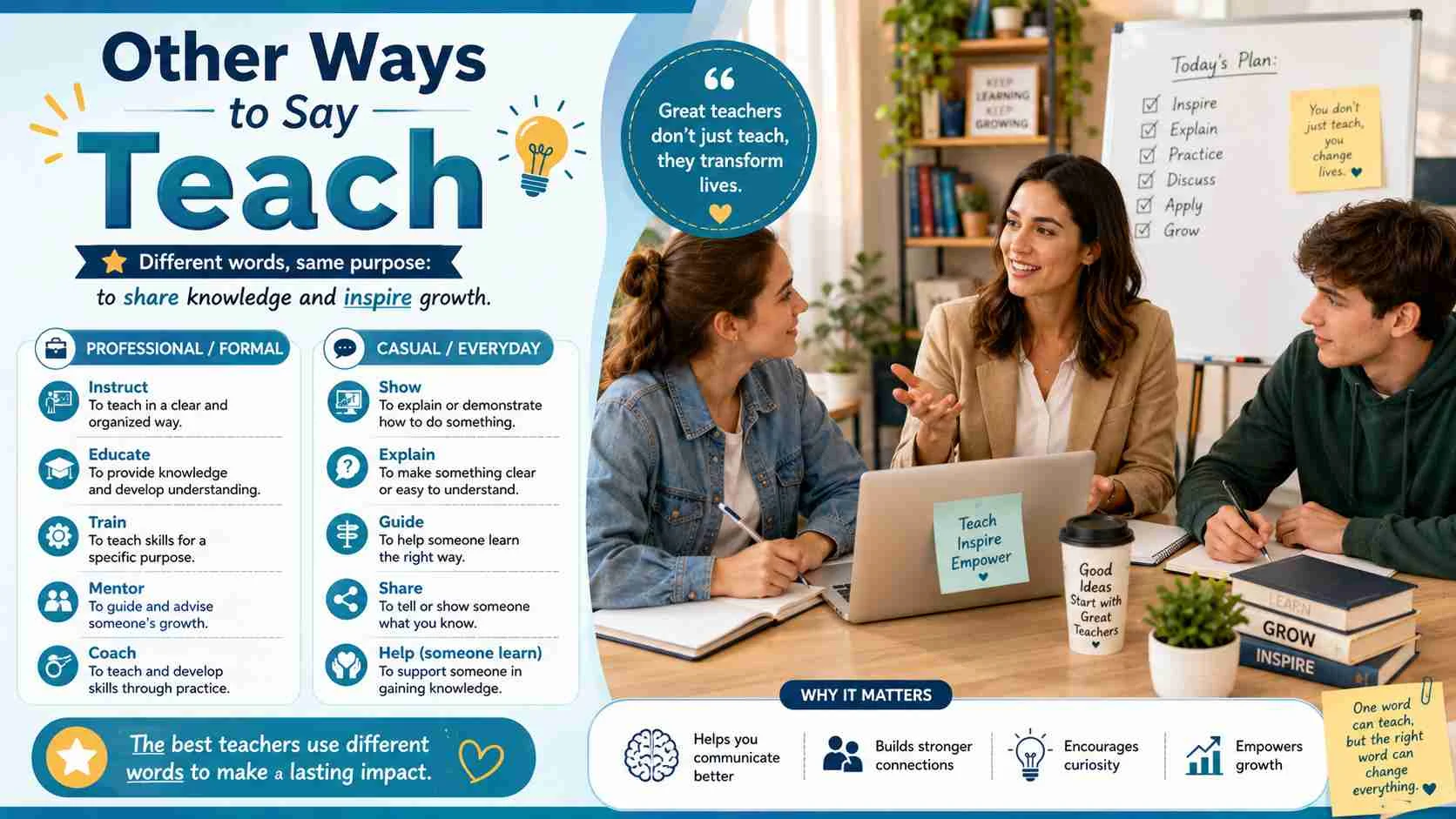
Some of the best other ways to say teach include educate, instruct, train, coach and guide. These alternatives help you sound more natural, professional and fluent in both spoken and written English.
The word “teach” is one of the most common verbs in English. People use it in schools, workplaces, training sessions, coaching conversations, and everyday communication.
However, repeating the same word too often can make your English sound limited. Learning alternatives to teach helps you communicate more clearly and choose the right tone for formal, casual, or professional situations.
If you want to express ideas more naturally, improve professional communication, and express excitement in English with better vocabulary, mastering other ways to say teach is an excellent step forward.
“Strong vocabulary helps your English sound confident, polished and natural.”
What Does “Teach” Mean?
“Teach” means to help someone learn knowledge, skills, or information.
It is commonly used as a verb in both spoken and written English.
Example Sentence:
- She teaches English at a local college.
When to Use “Teach”
You can use “teach” in many everyday situations:
- Classroom instruction
- Workplace training
- Giving advice
- Explaining skills
- Coaching someone
- Educational writing
- Online learning
Spoken vs Written
- Spoken English: Very common and natural
- Written English: Acceptable but sometimes repetitive
Formal vs Informal
- Formal: Less preferred in business leadership contexts
- Informal: Completely natural
“Choosing the right synonym can instantly improve your professional English.”
Is It Professional or Polite to Say “Teach”?
The word “teach” is polite and widely understood. However, in professional environments, some alternatives may sound more polished or specialized.
Business Example:
- Our senior manager will train new employees next week.
Polite? ✔️ Yes
Professional? ❌ No (in most cases)
Pros and Cons of Using “Teach”
Pros
- Simple and natural
- Friendly tone
- Common usage
- Easy to understand
Cons
- Too informal for some workplaces
- Overused in writing
- Limited emotional range
- Not ideal for formal communication
Quick Categories Section
Formal Alternatives to “Teach”
- Educate
- Instruct
- Mentor
- Tutor
Pro Tip
Use formal alternatives in academic writing, presentations, and workplace communication to sound more professional.
Casual Alternatives
- Show
- Help
- Walk through
- Explain
Pro Tip
Casual expressions work best in friendly conversations and everyday spoken English.
Professional Alternatives
- Train
- Coach
- Guide
- Develop
Pro Tip
Professional reaction phrases and workplace vocabulary improve business communication significantly.
Informal Expressions
- Fill someone in
- Bring someone up to speed
- Give pointers
- Show the ropes
Pro Tip
Informal expressions in English are useful for relaxed conversations but may sound unprofessional in formal emails.
“Professional vocabulary creates stronger first impressions.”
Common Mistakes When Using “Teach”
1. Using “teach” in every sentence
Incorrect:
- My boss teaches us sales and teaches us management.
2. Using overly casual phrases in formal writing
Incorrect:
- The professor showed us the theory.
3. Confusing “teach” with “learn”
Incorrect:
- She learned me English.
4. Using the wrong tone in business communication
Incorrect:
- I’ll show the new staff tomorrow.
5. Forgetting context differences
Incorrect:
- The coach educated the team during practice.
“Context matters as much as vocabulary.”
Other Ways to Say “Teach” With Examples
These alternatives will help you sound more fluent, confident, and natural in different situations.
Use them according to tone, context, and audience to express excitement, admiration, or approval.
1. Phrase | Educate
- Meaning: To provide knowledge or understanding.
- Explanation: Common in academic and formal contexts.
- Example Sentence: The program educates students about climate change.
- Best Use: Academic writing
- Worst Use: Casual chats
- Tone: Formal, educational
- Context Variability: Professional presentations, educational articles, formal speeches
2. Phrase | Instruct
- Meaning: To give detailed directions or knowledge.
- Explanation: Often used in training or technical settings.
- Example Sentence: The supervisor instructed employees on safety procedures.
- Best Use: Workplace training
- Worst Use: Friendly talk
- Tone: Direct, professional
- Context Variability: Manuals, meetings, spoken instruction
3. Phrase | Train
- Meaning: To develop skills through practice.
- Explanation: Frequently used in workplaces and sports.
- Example Sentence: The company trains new staff every month.
- Best Use: Employee development
- Worst Use: Academic essays
- Tone: Professional, practical
- Context Variability: HR communication, coaching, workshops
4. Phrase | Coach
- Meaning: To guide someone toward improvement.
- Explanation: Common in leadership and sports.
- Example Sentence: She coached the interns during the project.
- Best Use: Leadership settings
- Worst Use: Formal research
- Tone: Supportive, professional
- Context Variability: Business meetings, sports, mentoring
5. Phrase | Guide
- Meaning: To lead someone through a process.
- Explanation: Softer and more supportive than “teach.”
- Example Sentence: He guided me through the software setup.
- Best Use: Helpful instruction
- Worst Use: Strict authority
- Tone: Friendly, supportive
- Context Variability: Tutorials, onboarding, spoken English
6. Phrase | Mentor
- Meaning: To advise and support long term growth.
- Explanation: Often used in career development.
- Example Sentence: Senior employees mentor junior staff members.
- Best Use: Career growth
- Worst Use: Quick lessons
- Tone: Professional, supportive
- Context Variability: Corporate culture, education, networking
7. Phrase | Tutor
- Meaning: To teach individually or privately.
- Explanation: Common in academic contexts.
- Example Sentence: She tutors students after school.
- Best Use: Private lessons
- Worst Use: Corporate settings
- Tone: Academic, helpful
- Context Variability: Schools, online learning, tutoring sessions
8. Phrase | Show
- Meaning: To demonstrate how something works.
- Explanation: Very common in casual English.
- Example Sentence: Can you show me how this app works?
- Best Use: Everyday speech
- Worst Use: Formal reports
- Tone: Casual, friendly
- Context Variability: Spoken English, demonstrations, teamwork
9. Phrase | Demonstrate
- Meaning: To explain by showing examples.
- Explanation: Useful in presentations and teaching.
- Example Sentence: The instructor demonstrated the experiment.
- Best Use: Presentations
- Worst Use: Informal texting
- Tone: Formal, instructional
- Context Variability: Workshops, science classes, training
10. Phrase | Explain
- Meaning: To make something understandable.
- Explanation: One of the most versatile alternatives.
- Example Sentence: She explained the process clearly.
- Best Use: Clarification
- Worst Use: Skill training
- Tone: Neutral, clear
- Context Variability: Meetings, conversations, writing
11. Phrase | Walk Through
- Meaning: To explain step by step.
- Explanation: Common in business communication.
- Example Sentence: I’ll walk you through the report.
- Best Use: Tutorials
- Worst Use: Academic essays
- Tone: Professional, conversational
- Context Variability: Meetings, software training, presentations
12. Phrase | Develop
- Meaning: To help improve skills or abilities.
- Explanation: Frequently used in corporate settings.
- Example Sentence: Managers develop leadership skills in employees.
- Best Use: Professional growth
- Worst Use: Basic teaching
- Tone: Professional, strategic
- Context Variability: HR, coaching, leadership
13. Phrase | Enlighten
- Meaning: To provide deeper understanding.
- Explanation: More intellectual and formal.
- Example Sentence: The documentary enlightened viewers about history.
- Best Use: Intellectual topics
- Worst Use: Casual office talk
- Tone: Formal, thoughtful
- Context Variability: Essays, discussions, presentations
14. Phrase | Prepare
- Meaning: To get someone ready for something.
- Explanation: Common in training and education.
- Example Sentence: The workshop prepared students for interviews.
- Best Use: Readiness training
- Worst Use: Simple explanations
- Tone: Practical, professional
- Context Variability: Coaching, workshops, education
15. Phrase| Inform
- Meaning: To provide information.
- Explanation: Focuses more on knowledge sharing.
- Example Sentence: The seminar informed employees about policy changes.
- Best Use: Announcements
- Worst Use: Hands-on learning
- Tone: Formal, neutral
- Context Variability: Emails, meetings, notices
16. Phrase | Lecture
- Meaning: To teach formally through speaking.
- Explanation: Often used in universities.
- Example Sentence: The professor lectured on economics.
- Best Use: Academic speaking
- Worst Use: Friendly advice
- Tone: Formal, academic
- Context Variability: Universities, conferences, seminars
17. Phrase | Brief
- Meaning: To give concise instructions.
- Explanation: Common in business and military settings.
- Example Sentence: The manager briefed the team before the launch.
- Best Use: Short instructions
- Worst Use: Deep education
- Tone: Professional, concise
- Context Variability: Meetings, workplace communication, projects
18. Phrase | Advise
- Meaning: To recommend or guide.
- Explanation: Less direct than teaching.
- Example Sentence: She advised me on career choices.
- Best Use: Guidance
- Worst Use: Technical training
- Tone: Helpful, professional
- Context Variability: Mentoring, counseling, coaching
19. Phrase | School
- Meaning: To educate formally.
- Explanation: Slightly old fashioned but still used.
- Example Sentence: His grandfather schooled him in business ethics.
- Best Use: Storytelling
- Worst Use: Corporate emails
- Tone: Literary, formal
- Context Variability: Narratives, historical writing, speeches
20. Phrase| Drill
- Meaning: To train through repetition.
- Explanation: Common in sports and military training.
- Example Sentence: The coach drilled players on defense strategies.
- Best Use: Repetitive practice
- Worst Use: Friendly conversation
- Tone: Strict, disciplined
- Context Variability: Sports, military, intensive training
21. Phrase | Introduce
- Meaning: To teach basic understanding.
- Explanation: Used for beginner learning.
- Example Sentence: The course introduces students to coding.
- Best Use: Beginner lessons
- Worst Use: Advanced expertise
- Tone: Neutral, educational
- Context Variability: Courses, workshops, classes
22. Phrase | Familiarize
- Meaning: To help someone become comfortable with something.
- Explanation: Common in onboarding contexts.
- Example Sentence: The session familiarized staff with company tools.
- Best Use: Onboarding
- Worst Use: Casual speech
- Tone: Professional, supportive
- Context Variability: HR training, orientation, business
23. Phrase | Shape
- Meaning: To influence development or behavior.
- Explanation: Often used metaphorically.
- Example Sentence: Great teachers shape future leaders.
- Best Use: Inspirational writing
- Worst Use: Technical instruction
- Tone: Thoughtful, motivational
- Context Variability: Speeches, essays, education
24. Phrase | Nurture
- Meaning: To support gradual growth.
- Explanation: Focuses on encouragement and care.
- Example Sentence: Good mentors nurture creativity.
- Best Use: Personal development
- Worst Use: Strict instruction
- Tone: Warm, supportive
- Context Variability: Coaching, parenting, mentoring
25. Phrase | Show the Ropes
- Meaning: To teach someone how things work.
- Explanation: Informal workplace expression.
- Example Sentence: Sarah showed me the ropes on my first day.
- Best Use: Informal onboarding
- Worst Use: Formal reports
- Tone: Casual, friendly
- Context Variability: Offices, casual speech, teamwork
26. Phrase | Bring Up to Speed
- Meaning: To update someone quickly.
- Explanation: Very common in business English.
- Example Sentence: Please bring the new hire up to speed.
- Best Use: Workplace updates
- Worst Use: Academic essays
- Tone: Professional, conversational
- Context Variability: Meetings, onboarding, office communication
27. Phrase | Give Pointers
- Meaning: To offer useful advice.
- Explanation: Informal but helpful.
- Example Sentence: He gave me pointers for the interview.
- Best Use: Friendly advice
- Worst Use: Formal lectures
- Tone: Casual, supportive
- Context Variability: Conversations, mentoring, coaching
28. Phrase | Share Knowledge
- Meaning: To pass information to others.
- Explanation: Collaborative and professional sounding.
- Example Sentence: Experienced workers should share knowledge regularly.
- Best Use: Team collaboration
- Worst Use: Strict instruction
- Tone: Professional, cooperative
- Context Variability: Business culture, teamwork, learning
29. Phrase | Lead
- Meaning: To direct or guide others.
- Explanation: Implies authority and direction.
- Example Sentence: She led the trainees through the exercise.
- Best Use: Leadership training
- Worst Use: Casual teaching
- Tone: Strong, professional
- Context Variability: Workshops, leadership, projects
30. Phrase | Inspire
- Meaning: To motivate learning or action.
- Explanation: Emotional and motivational alternative.
- Example Sentence: Great educators inspire lifelong learning.
- Best Use: Motivational speaking
- Worst Use: Technical manuals
- Tone: Inspirational, positive
- Context Variability: Speeches, education, leadership
“Fluent English is not about difficult words. It is about choosing the right words.”
Comparison Table | Top Alternatives
| Phrase | Tone | Best Use |
|---|---|---|
| Educate | Formal | Academic writing |
| Train | Professional | Employee training |
| Coach | Supportive | Leadership |
| Guide | Friendly | Tutorials |
| Mentor | Professional | Career growth |
| Explain | Neutral | Clarification |
| Demonstrate | Formal | Presentations |
| Walk Through | Conversational | Business tutorials |
| Show | Casual | Everyday speech |
| Inspire | Motivational | Speeches |
Mini Quiz / Self Check
1. Which phrase sounds most professional in a workplace?
- A. Show
- B. Train
- C. Fill in
Correct Answer: B. Train
2. Which alternative is best for casual spoken English?
- A. Demonstrate
- B. Educate
- C. Show
Correct Answer: C. Show
3. Which phrase is best for long term career support?
- A. Mentor
- B. Drill
- C. Lecture
Correct Answer: A. Mentor
4. Which expression is too informal for academic writing?
- A. Instruct
- B. Show the ropes
- C. Educate
Correct Answer: B. Show the ropes
“The right tone makes your English sound professional and confident.”
FAQs
What are the best professional alternatives to “teach”?
Professional alternatives to teach include train, coach, mentor, instruct, and develop.
What is a formal synonym for “teach”?
“Educate” and “instruct” are two of the most formal alternatives to teach.
Can I use “teach” in business communication?
Yes, but professional alternatives often sound more polished in meetings, emails, and workplace discussions.
What are casual alternatives to “teach”?
Casual alternatives include show, explain, walk through, and give pointers.
Why should I learn other ways to say teach?
Learning other ways to say teach improves fluency, expands vocabulary, and helps you choose the correct tone for different situations.
Conclusion
Learning other ways to say teach helps you sound more natural, confident, and professional in English conversations and writing. Different alternatives work better in different situations, so understanding tone and context is extremely important.
Practice these phrases daily in emails, conversations, presentations, and professional settings. The more vocabulary you use naturally, the more fluent and polished your English will become.