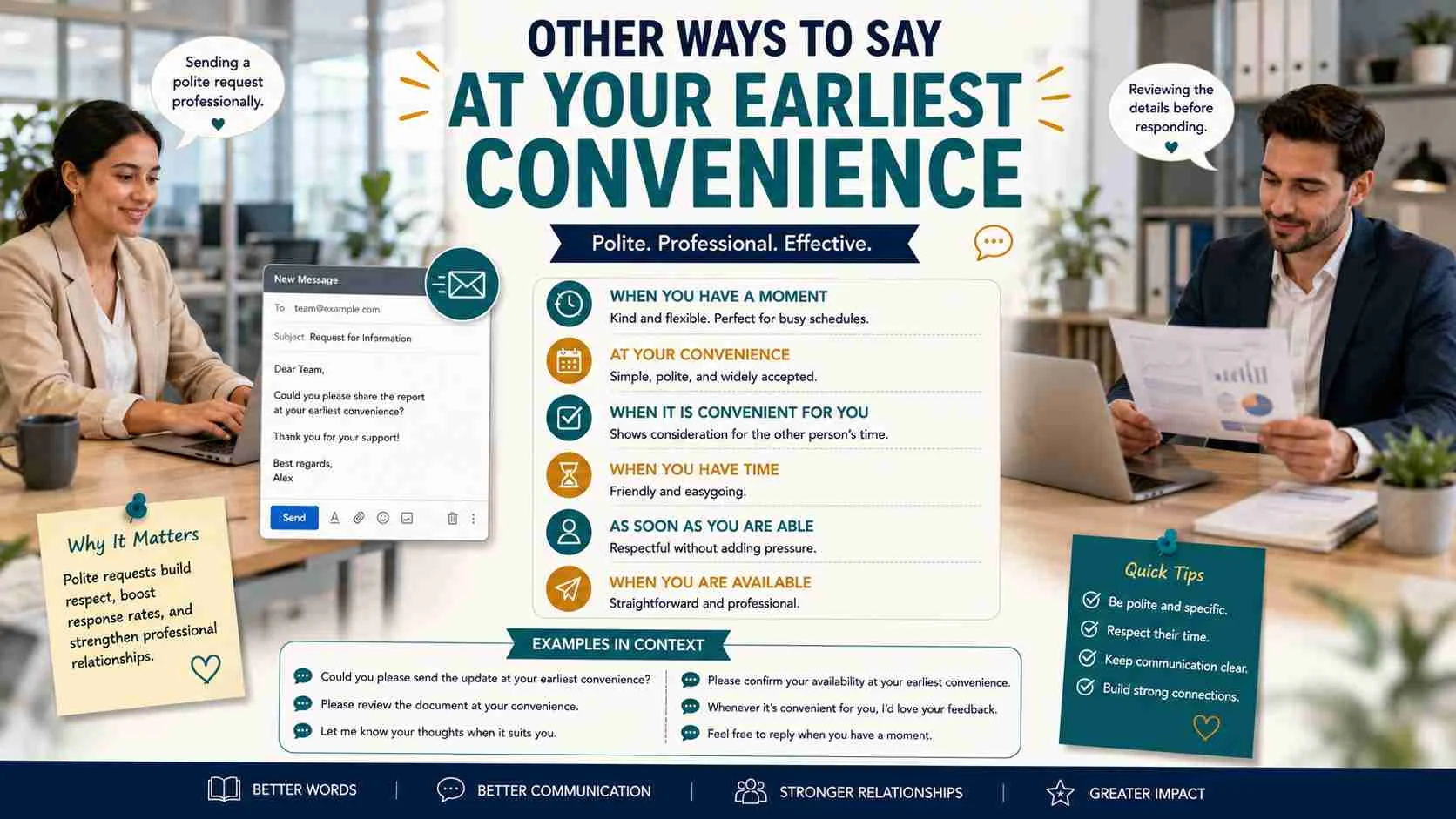
The phrase “at your earliest convenience” is a polite way to ask someone to do something as soon as they reasonably can. Some of the best other ways to say at your earliest convenience include when you have a moment, as soon as possible, when it’s convenient for you, at your first opportunity, and when you get a chance.
The expression “at your earliest convenience” is commonly used in emails, business communication, and polite requests. It tells someone you’d appreciate their action soon without sounding demanding.
Although the phrase is polite, using the same wording repeatedly can make your writing sound repetitive. Learning alternatives to at your earliest convenience helps you communicate more naturally in both professional and everyday English.
Expanding your vocabulary also improves your confidence in conversations and emails. Just as learners discover better ways to express excitement in English, knowing different ways to make polite requests helps your communication sound more fluent and appropriate.
Formal Alternatives to “At Your Earliest Convenience”
- At your first opportunity
- At your earliest opportunity
- As soon as practicable
- At a time convenient for you
Pro Tip
Choose formal expressions for business emails, official requests, and workplace communication. They sound respectful without appearing too casual.
Casual Alternatives
- When you get a chance
- Whenever you can
- When you have a minute
- If you have some time
Pro Tip
Casual alternatives work best with friends, family, classmates, or coworkers you know well.
Professional Alternatives
- Please respond as soon as possible
- When your schedule allows
- At your convenience
- As soon as your schedule permits
Pro Tip
Professional alternatives balance politeness and efficiency, making them ideal for workplace emails.
Informal Expressions
- When you can
- Whenever you’re free
- If you don’t mind
- Once you have time
Pro Tip
Informal expressions sound friendly but should generally be avoided in formal business documents.
The right tone makes your English sound professional, confident and respectful.
Common Mistakes Using “At Your Earliest Convenience”
1. Using it in urgent situations
Example:
“I need this in ten minutes at your earliest convenience.”
If something is urgent, say “as soon as possible” instead.
2. Using it with close friends
Example:
“Call me at your earliest convenience.”
With friends, “Call me when you get a chance.” sounds much more natural.
3. Overusing the phrase
Example:
Every email ends with “at your earliest convenience.”
Repeating the same phrase can make your writing feel repetitive.
4. Using it without saying what you need
Example:
“Please reply at your earliest convenience.”
Instead, specify the request.
“Please review the attached document at your earliest convenience.”
5. Using it for immediate deadlines
Example:
“I need the report in five minutes at your earliest convenience.”
This creates confusion because the phrase suggests flexibility rather than urgency.
Politeness is important, but clarity is even more important.
What Does “At Your Earliest Convenience” Mean?
The phrase “at your earliest convenience” means as soon as you are reasonably able to do something without unnecessary delay.
Grammatically, it is a prepositional phrase that politely modifies a request.
Example Sentence
“Please send the signed contract at your earliest convenience.”
When to Use “At Your Earliest Convenience”
- Business emails
- Professional requests
- Customer service communication
- Academic correspondence
- Requests for documents
- Following up on tasks
- Speaking politely with colleagues
Spoken vs Written
It appears much more often in written English, especially emails and letters.
Formal vs Informal
It is generally considered formal and polite.
Is It Professional or Polite to Say “At Your Earliest Convenience”?
The phrase is certainly polite because it respects the other person’s schedule.
However, many workplaces now prefer clearer and more direct language. Instead of sounding overly formal, professionals often choose simpler alternatives.
Business Example
“Please review the proposal when your schedule allows.”
Polite? ✔️ Yes
Professional? ❌ No (in most modern workplaces)
Pros and Cons of Using “At Your Earliest Convenience”
Pros
- Simple and natural
- Friendly tone
- Common usage
- Easy to understand
Cons
- Too formal for many workplaces
- Overused
- Limited emotional range
- Not suitable for every professional writing style
Using different expressions helps your English sound more natural and engaging.
Other Ways to Say “At Your Earliest Convenience” With Examples
These other ways to say at your earliest convenience will help you sound more fluent, confident, and natural in different situations.
Use these alternatives according to your audience, tone, and communication style.
1. Phrase | As Soon As Possible
- Meaning: Complete the task without unnecessary delay.
- Explanation: A direct and commonly used alternative.
- Example Sentence: Please send the invoice as soon as possible.
- Best Use: Urgent emails
- Worst Use: Casual chats
- Tone: Direct, polite, efficient
- Context Variability: Casual, professional, spoken
2. Phrase | When You Get a Chance
- Meaning: Do it whenever you have free time.
- Explanation: Friendly and relaxed.
- Example Sentence: Could you check this when you get a chance?
- Best Use: Coworkers, friends
- Worst Use: Legal letters
- Tone: Casual, polite, friendly
- Context Variability: Casual, spoken, workplace
3. Phrase | At Your Convenience
- Meaning: Whenever it suits your schedule.
- Explanation: A shorter formal version.
- Example Sentence: Please contact me at your convenience.
- Best Use: Business emails
- Worst Use: Urgent requests
- Tone: Formal, respectful, professional
- Context Variability: Professional, written
4. Phrase | When It’s Convenient for You
- Meaning: Whenever it fits your schedule.
- Explanation: Sounds thoughtful and considerate.
- Example Sentence: Let’s meet when it’s convenient for you.
- Best Use: Scheduling
- Worst Use: Emergencies
- Tone: Polite, considerate, friendly
- Context Variability: Professional, spoken
5. Phrase | At Your First Opportunity
- Meaning: At the earliest reasonable time.
- Explanation: A highly formal alternative.
- Example Sentence: Please submit the paperwork at your first opportunity.
- Best Use: Official requests
- Worst Use: Informal chats
- Tone: Formal, respectful, courteous
- Context Variability: Business, academic
6. Phrase | When You Have a Moment
- Meaning: Whenever you have a little free time.
- Explanation: Friendly and natural.
- Example Sentence: Could you call me when you have a moment?
- Best Use: Everyday conversations
- Worst Use: Urgent deadlines
- Tone: Warm, polite, casual
- Context Variability: Spoken, casual
7. Phrase | Whenever You Can
- Meaning: At any suitable time.
- Explanation: Shows flexibility.
- Example Sentence: Finish the review whenever you can.
- Best Use: Friendly requests
- Worst Use: Time sensitive tasks
- Tone: Relaxed, polite, flexible
- Context Variability: Casual, spoken
8. Phrase | As Soon As Your Schedule Permits
- Meaning: Once your timetable allows.
- Explanation: Professional and respectful.
- Example Sentence: Please respond as soon as your schedule permits.
- Best Use: Executive emails
- Worst Use: Casual texts
- Tone: Professional, courteous, formal
- Context Variability: Workplace
9. Phrase | When Time Allows
- Meaning: Whenever you have available time.
- Explanation: A concise professional expression.
- Example Sentence: Please review the file when time allows.
- Best Use: Internal emails
- Worst Use: Emergencies
- Tone: Neutral, polite, professional
- Context Variability: Professional
10. Phrase | At Your Earliest Opportunity
- Meaning: At the first practical chance.
- Explanation: Very similar to the original phrase.
- Example Sentence: Kindly reply at your earliest opportunity.
- Best Use: Formal letters
- Worst Use: Friendly conversation
- Tone: Formal, respectful, traditional
- Context Variability: Business, academic
11. Phrase | As Soon As Practicable
- Meaning: As soon as it is practical.
- Explanation: Common in legal and official writing.
- Example Sentence: Complete the report as soon as practicable.
- Best Use: Legal writing
- Worst Use: Daily conversation
- Tone: Formal, official, precise
- Context Variability: Professional
12. Phrase | When Your Schedule Allows
- Meaning: Whenever your calendar is free.
- Explanation: Respectful and modern.
- Example Sentence: Please call me when your schedule allows.
- Best Use: Workplace communication
- Worst Use: Immediate requests
- Tone: Professional, considerate, polite
- Context Variability: Professional, spoken
13. Phrase | Once You Have Time
- Meaning: Whenever you’re available.
- Explanation: Sounds relaxed and conversational.
- Example Sentence: Take a look once you have time.
- Best Use: Friends, coworkers
- Worst Use: Formal contracts
- Tone: Friendly, casual, polite
- Context Variability: Casual, spoken
14. Phrase | If You Have a Minute
- Meaning: If you have a brief moment available.
- Explanation: A common conversational request.
- Example Sentence: Can we talk if you have a minute?
- Best Use: Conversations
- Worst Use: Official documents
- Tone: Friendly, natural, relaxed
- Context Variability: Spoken, casual
15. Phrase | As Early As You Can
- Meaning: Complete it reasonably soon.
- Explanation: Simple and easy to understand.
- Example Sentence: Please finish the edits as early as you can.
- Best Use: Everyday English
- Worst Use: Formal legal writing
- Tone: Simple, polite, conversational
- Context Variability: Casual, workplace
Choosing the right alternative depends on your audience, your purpose and the level of formality you want to convey.
16. Phrase | When You Have Some Time
- Meaning: Whenever you have free time available.
- Explanation: A relaxed and considerate request.
- Example Sentence: Please review the document when you have some time.
- Best Use: Friendly requests
- Worst Use: Emergency situations
- Tone: Casual, polite, warm
- Context Variability: Casual, spoken, workplace
17. Phrase | At a Time That Suits You
- Meaning: Whenever it is convenient for you.
- Explanation: Shows respect for the other person’s schedule.
- Example Sentence: We can discuss the proposal at a time that suits you.
- Best Use: Scheduling meetings
- Worst Use: Urgent tasks
- Tone: Professional, courteous, flexible
- Context Variability: Professional, spoken
18. Phrase | At Your Leisure
- Meaning: Whenever you have plenty of free time.
- Explanation: Indicates there is no immediate deadline.
- Example Sentence: Read the report at your leisure.
- Best Use: Nonurgent requests
- Worst Use: Time sensitive work
- Tone: Relaxed, polite, formal
- Context Variability: Professional, written
19. Phrase | Whenever It Works for You
- Meaning: At any time that fits your schedule.
- Explanation: Friendly and accommodating.
- Example Sentence: Let’s meet whenever it works for you.
- Best Use: Arranging meetings
- Worst Use: Formal notices
- Tone: Friendly, considerate, casual
- Context Variability: Spoken, casual
20. Phrase | As Promptly As Possible
- Meaning: Complete the task quickly.
- Explanation: Slightly more formal than “as soon as possible.”
- Example Sentence: Please return the signed agreement as promptly as possible.
- Best Use: Business communication
- Worst Use: Informal chats
- Tone: Professional, direct, polite
- Context Variability: Professional, written
21. Phrase | Without Undue Delay
- Meaning: Complete it without unnecessary waiting.
- Explanation: Often found in legal or official documents.
- Example Sentence: Please submit the requested documents without undue delay.
- Best Use: Legal writing
- Worst Use: Everyday conversation
- Tone: Formal, official, precise
- Context Variability: Professional, legal
22. Phrase | At the Earliest Opportunity
- Meaning: At the first available chance.
- Explanation: A respectful formal request.
- Example Sentence: Kindly contact our office at the earliest opportunity.
- Best Use: Official emails
- Worst Use: Friendly texts
- Tone: Formal, respectful, professional
- Context Variability: Business, academic
23. Phrase | Kindly Respond Soon
- Meaning: Please reply in the near future.
- Explanation: Polite and direct.
- Example Sentence: Kindly respond soon so we can finalize the schedule.
- Best Use: Customer communication
- Worst Use: Casual conversation
- Tone: Courteous, direct, professional
- Context Variability: Professional
24. Phrase | As Soon As You Are Able
- Meaning: Whenever you are capable of doing it.
- Explanation: Shows empathy and flexibility.
- Example Sentence: Please complete the form as soon as you are able.
- Best Use: Supportive requests
- Worst Use: Strict deadlines
- Tone: Kind, polite, considerate
- Context Variability: Professional, personal
25. Phrase | At the Next Available Opportunity
- Meaning: The next suitable chance.
- Explanation: Common in formal communication.
- Example Sentence: Please update the records at the next available opportunity.
- Best Use: Workplace tasks
- Worst Use: Friendly chats
- Tone: Formal, professional, respectful
- Context Variability: Professional
26. Phrase | Please Prioritize This
- Meaning: Give this task higher importance.
- Explanation: Appropriate when the request is important.
- Example Sentence: Please prioritize this request before tomorrow’s meeting.
- Best Use: Team projects
- Worst Use: Social conversations
- Tone: Direct, professional, clear
- Context Variability: Workplace
27. Phrase | When You Find Time
- Meaning: Whenever you become available.
- Explanation: A natural conversational alternative.
- Example Sentence: Could you review my resume when you find time?
- Best Use: Friendly communication
- Worst Use: Emergency requests
- Tone: Casual, polite, friendly
- Context Variability: Casual, spoken
28. Phrase | At Your Next Convenience
- Meaning: At your next suitable opportunity.
- Explanation: Similar to the original phrase but less common.
- Example Sentence: Please stop by my office at your next convenience.
- Best Use: Office communication
- Worst Use: Highly urgent tasks
- Tone: Formal, courteous, respectful
- Context Variability: Professional
29. Phrase | Whenever You Are Available
- Meaning: At any time you are free.
- Explanation: Frequently used for arranging meetings.
- Example Sentence: Please let me know whenever you are available.
- Best Use: Scheduling
- Worst Use: Time critical requests
- Tone: Friendly, professional, polite
- Context Variability: Spoken, workplace
30. Phrase | As Circumstances Allow
- Meaning: Whenever your situation makes it possible.
- Explanation: Suitable when flexibility is important.
- Example Sentence: Please complete the training as circumstances allow.
- Best Use: Flexible deadlines
- Worst Use: Immediate action
- Tone: Formal, thoughtful, flexible
- Context Variability: Professional, written
The strongest communicators choose their words based on the situation, not habit.
Small vocabulary changes can make your English sound more natural and professional.
Comparison Table | Top Alternatives
| Phrase | Tone | Best Use |
|---|---|---|
| As soon as possible | Direct | Urgent requests |
| When you get a chance | Casual | Friends, coworkers |
| At your convenience | Professional | Business emails |
| When it’s convenient for you | Polite | Scheduling |
| At your first opportunity | Formal | Official communication |
| When you have a moment | Friendly | Everyday conversations |
| As soon as your schedule permits | Professional | Executive emails |
| When your schedule allows | Professional | Workplace requests |
| At the earliest opportunity | Formal | Business letters |
| Whenever you are available | Neutral | Meetings and appointments |
Mini Quiz
1. Which phrase is the most suitable for a formal business email?
A. When you get a chance
B. At your convenience
C. Whenever you’re free
D. If you have a minute
Answer: B
2. Which expression sounds the most casual?
A. As soon as practicable
B. At your first opportunity
C. When you have a moment
D. Without undue delay
Answer: C
3. Which phrase is best for a legal document?
A. Whenever you can
B. Without undue delay
C. When you find time
D. If you have a minute
Answer: B
4. Your manager asks you to write a polite meeting request. Which expression fits best?
A. At your convenience
B. Whenever you’re free
C. When you get a chance
D. Once you have time
Answer: A
Learning tone is just as important as learning vocabulary.
FAQs
What are the best other ways to say at your earliest convenience?
Some of the best alternatives include as soon as possible, at your convenience, when you have a moment, when you get a chance, and at your first opportunity. Each works best in different situations depending on the level of formality.
Is “at your earliest convenience” still professional?
Yes, it is polite and professional, but many modern workplaces prefer clearer expressions such as when your schedule allows or at your convenience, which sound more natural in business communication.
What is a less formal alternative to at your earliest convenience?
For everyday conversations, you can say when you get a chance, when you have a minute, whenever you can, or once you have time. These informal expressions in English sound friendly and natural.
Can I use “at your earliest convenience” in an email?
Yes. It is appropriate for business emails, customer service messages, academic correspondence, and professional requests where you want to remain polite without demanding immediate action.
Why should I learn alternatives to at your earliest convenience?
Learning other ways to say at your earliest convenience improves your fluency, helps you avoid repetition, and allows you to choose the most suitable expression for different audiences and communication styles.
Conclusion
Learning other ways to say at your earliest convenience makes your English more flexible, natural, and professional. Instead of relying on one expression, you can choose the phrase that best fits the situation, you’re writing a business email, speaking with colleagues, or communicating with friends.
The more you practice these alternatives, the more confident you’ll become in both spoken and written English. Pay attention to tone, context, and your audience, and you’ll communicate with greater clarity and professionalism.
Discover More Related Articles:
- Other Ways to Say Provide | Fresh Alternatives for Everyday Writing In 2026
- Other Ways to Say Helped | Smart Replacements for Better Writing In 2026
- Other Ways to Say Leadership | Powerful Words That Inspire Authority In 2026