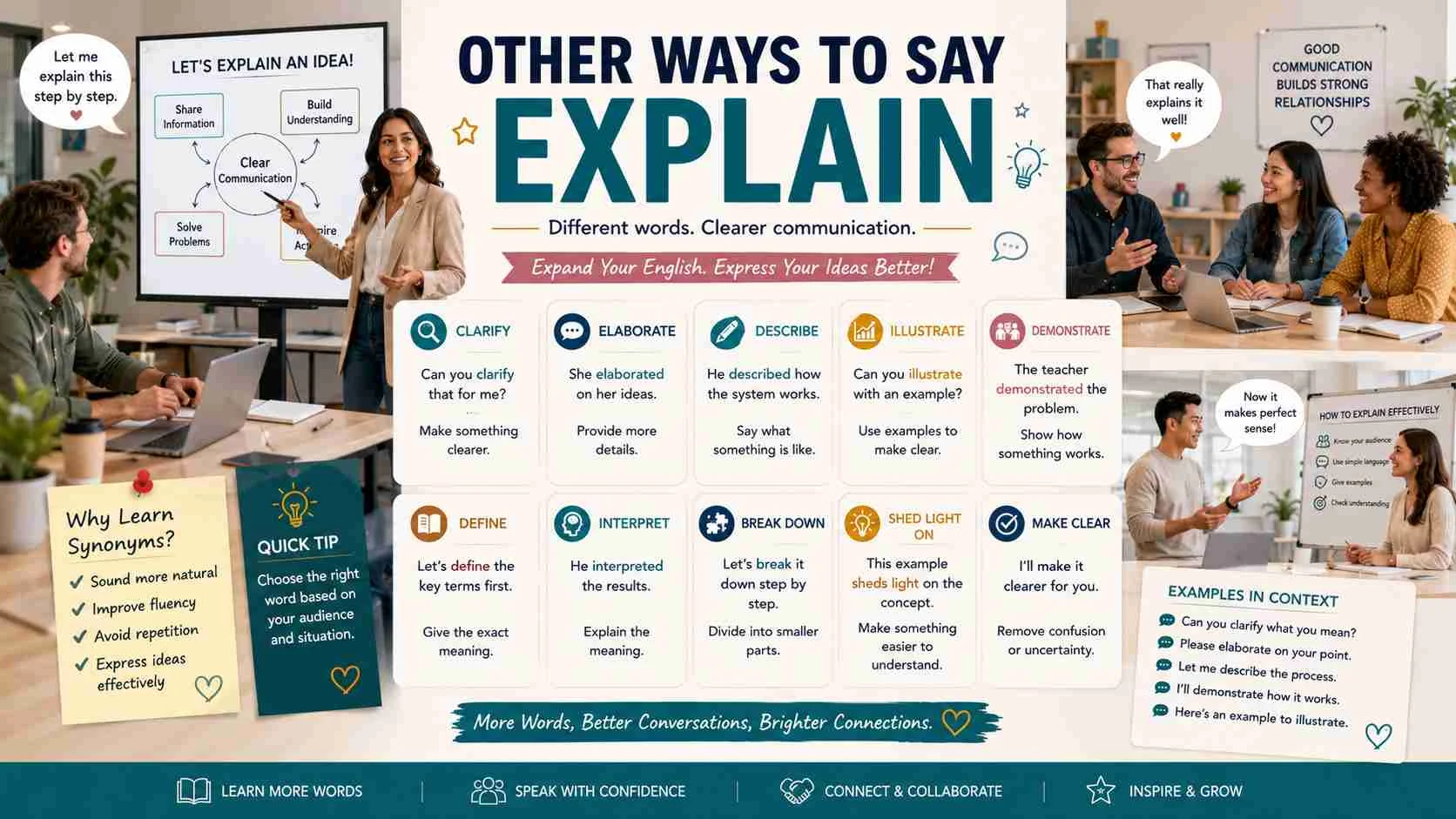
If you want other ways to say explain, try phrases like clarify, illustrate, describe, elaborate on and break down. Using different expressions helps you sound more natural, professional and fluent in both speaking and writing.
The verb “explain” means to make something clear or easy to understand. It’s one of the most common English words, but repeating it too often can make your writing and conversations sound repetitive.
Learning alternatives to explain helps you choose the best phrase for different situations. Some expressions sound more formal, while others are perfect for casual conversations or workplace communication.
Expanding your vocabulary also improves fluency and confidence. you’re giving a presentation, teaching, writing emails, or trying to express excitement in English, choosing the right wording makes your message stronger.
“Using the right alternative can instantly make your English sound more professional and natural.”
Formal Alternatives to “Explain”
- Clarify
- Elaborate
- Interpret
- Demonstrate
Pro Tip: Use formal alternatives in reports, presentations, academic writing, and business emails.
Casual Alternatives
- Break it down
- Walk me through
- Tell me more
- Spell it out
Pro Tip: Casual phrases sound natural during everyday conversations with friends and family.
Professional Alternatives
- Provide clarification
- Outline
- Present
- Illustrate
Pro Tip: Professional expressions improve workplace communication and make presentations more polished.
Informal Expressions
- Fill me in
- Give me the details
- Lay it out
- Put it simply
Pro Tip: Use informal expressions only in relaxed conversations, never in formal business writing.
“Professional English isn’t about difficult words. It’s about choosing the right words.”
Common Mistakes When Using “Explain”
1. Repeating “Explain” Too Often
Example:
Can you explain this? Please explain it again. I will explain later.
2. Using It in Very Formal Reports
Example:
Better: Clarify the procedure instead of Explain the procedure.
3. Using It Without Enough Details
Example:
He explained.
Better:
He explained the process step by step.
4. Using the Wrong Tone
Example:
“Break it down” is too casual in business meetings.
5. Forgetting the Audience
Example:
Children need simple explanations while professionals often expect detailed clarification.
What Does “Explain” Mean?
Explain means to make something understandable by giving information or reasons.
It is a regular verb commonly followed by explain something or explain something to someone.
Example:
The teacher explained the lesson clearly.
When to Use “Explain”
- Teaching someone
- Giving instructions
- Answering questions
- Writing reports
- Business meetings
- Customer support
- Presentations
- Academic writing
Spoken vs Written
- Spoken: Very common
- Written: Common but sometimes better replaced with more specific alternatives.
Formal vs Informal
- Formal: Acceptable
- Informal: Very common
Is It Professional or Polite to Say “Explain”?
The word explain is polite and widely accepted.
Business Example:
Could you explain the new project timeline?
Polite? ✔️ Yes
Professional? ❌ No (in most cases, more precise verbs like clarify or outline sound stronger.)
“Small vocabulary changes create a big professional impression.”
Pros and Cons of Using “Explain”
Pros
- Simple and natural
- Friendly tone
- Common usage
- Easy to understand
Cons
- Too informal for some workplaces
- Frequently overused
- Limited emotional range
- Not ideal for formal writing
Other Ways to Say “Explain” With Examples
These other ways to say explain will help you sound more fluent, confident, and natural in different situations.
Choose the alternative based on your audience, tone, and purpose.
1. Phrase | Clarify
- Meaning: Make something easier to understand.
- Explanation: Removes confusion.
- Example Sentence: Could you clarify your last point?
- Best Use: Business meetings
- Worst Use: Casual jokes
- Tone: Professional, polite
- Context Variability: Professional, written, spoken
2. Phrase | Elaborate
- Meaning: Add more details.
- Explanation: Expands an idea.
- Example Sentence: Could you elaborate on your proposal?
- Best Use: Presentations
- Worst Use: Short chats
- Tone: Formal, detailed
- Context Variability: Professional, spoken
3. Phrase | Describe
- Meaning: Give details.
- Explanation: Paints a clear picture.
- Example Sentence: Please describe the situation.
- Best Use: Reports
- Worst Use: Technical analysis
- Tone: Neutral, informative
- Context Variability: Casual, professional
4. Phrase | Illustrate
- Meaning: Explain using examples.
- Explanation: Makes concepts easier.
- Example Sentence: The chart illustrates the trend.
- Best Use: Education
- Worst Use: Text messages
- Tone: Professional, educational
- Context Variability: Professional
5. Phrase | Demonstrate
- Meaning: Show how something works.
- Explanation: Uses actions or examples.
- Example Sentence: Let me demonstrate the process.
- Best Use: Training
- Worst Use: Casual talk
- Tone: Clear, instructional
- Context Variability: Professional
6. Phrase | Outline
- Meaning: Give the main points.
- Explanation: Provides structure.
- Example Sentence: She outlined the plan.
- Best Use: Meetings
- Worst Use: Friendly chat
- Tone: Professional, concise
- Context Variability: Professional
7. Phrase | Define
- Meaning: State the exact meaning.
- Explanation: Gives a clear definition.
- Example Sentence: Define the term first.
- Best Use: Education
- Worst Use: Storytelling
- Tone: Academic, precise
- Context Variability: Written
8. Phrase | Interpret
- Meaning: Explain meaning.
- Explanation: Gives understanding.
- Example Sentence: Interpret the results carefully.
- Best Use: Analysis
- Worst Use: Casual talk
- Tone: Formal, analytical
- Context Variability: Professional
9. Phrase | Decode
- Meaning: Make understandable.
- Explanation: Simplifies complex information.
- Example Sentence: He decoded the message.
- Best Use: Technical topics
- Worst Use: Greetings
- Tone: Informative
- Context Variability: Professional
10. Phrase | Simplify
- Meaning: Make easier.
- Explanation: Removes complexity.
- Example Sentence: Please simplify the instructions.
- Best Use: Teaching
- Worst Use: Legal contracts
- Tone: Helpful
- Context Variability: Spoken
11. Phrase | Break it down
- Meaning: Explain simply.
- Explanation: Uses easy language.
- Example Sentence: Can you break it down for me?
- Best Use: Casual conversation
- Worst Use: Formal reports
- Tone: Friendly
- Context Variability: Casual
12. Phrase | Walk someone through
- Meaning: Explain step by step.
- Explanation: Gives guidance.
- Example Sentence: Walk me through the process.
- Best Use: Training
- Worst Use: Essays
- Tone: Helpful
- Context Variability: Spoken
13. Phrase | Spell it out
- Meaning: Explain clearly.
- Explanation: Leaves no confusion.
- Example Sentence: Please spell it out.
- Best Use: Informal discussion
- Worst Use: Academic paper
- Tone: Direct
- Context Variability: Casual
14. Phrase | Go over
- Meaning: Review together.
- Explanation: Explains again.
- Example Sentence: Let’s go over the instructions.
- Best Use: Meetings
- Worst Use: Legal writing
- Tone: Friendly
- Context Variability: Spoken
15. Phrase | Talk through
- Meaning: Discuss while explaining.
- Explanation: Collaborative explanation.
- Example Sentence: Let’s talk through the options.
- Best Use: Teamwork
- Worst Use: Formal essays
- Tone: Cooperative
- Context Variability: Professional
16. Phrase | Teach
- Meaning: Help someone learn.
- Explanation: Gives knowledge.
- Example Sentence: She taught us grammar.
- Best Use: Education
- Worst Use: Negotiation
- Tone: Educational
- Context Variability: Spoken
17. Phrase | Inform
- Meaning: Give information.
- Explanation: Shares facts.
- Example Sentence: Inform the clients.
- Best Use: Business
- Worst Use: Friendly stories
- Tone: Professional
- Context Variability: Written
18. Phrase | Present
- Meaning: Share information.
- Explanation: Organized communication.
- Example Sentence: Present your findings.
- Best Use: Presentations
- Worst Use: Casual talk
- Tone: Formal
- Context Variability: Professional
19. Phrase | Reveal
- Meaning: Make known.
- Explanation: Shares hidden information.
- Example Sentence: The report revealed the truth.
- Best Use: Reports
- Worst Use: Instructions
- Tone: Serious
- Context Variability: Written
20. Phrase | Convey
- Meaning: Communicate meaning.
- Explanation: Expresses ideas.
- Example Sentence: The image conveys hope.
- Best Use: Writing
- Worst Use: Casual jokes
- Tone: Professional
- Context Variability: Written
21. Phrase | Decode
- Meaning: Make understandable.
- Explanation: Explains complex information.
- Example Sentence: Decode the instructions.
- Best Use: Technical
- Worst Use: Greetings
- Tone: Clear
- Context Variability: Professional
22. Phrase | Expound
- Meaning: Explain thoroughly.
- Explanation: Gives detailed understanding.
- Example Sentence: The professor expounded the theory.
- Best Use: Academia
- Worst Use: Small talk
- Tone: Formal
- Context Variability: Professional
23. Phrase | Unpack
- Meaning: Explain in detail.
- Explanation: Breaks ideas into parts.
- Example Sentence: Let’s unpack this concept.
- Best Use: Workshops
- Worst Use: Legal writing
- Tone: Modern
- Context Variability: Professional
24. Phrase | Interpret
- Meaning: Explain meaning.
- Explanation: Offers understanding.
- Example Sentence: Interpret the graph.
- Best Use: Analysis
- Worst Use: Casual chatting
- Tone: Analytical
- Context Variability: Professional
25. Phrase | Make Clear
- Meaning: Remove confusion.
- Explanation: States clearly.
- Example Sentence: She made the rules clear.
- Best Use: Teaching
- Worst Use: Literature
- Tone: Friendly
- Context Variability: Spoken
26. Phrase | Give Details
- Meaning: Share more information.
- Explanation: Adds specifics.
- Example Sentence: Please give more details.
- Best Use: Conversations
- Worst Use: Headlines
- Tone: Neutral
- Context Variability: Casual
27. Phrase | Explain Further
- Meaning: Add more explanation.
- Explanation: Continues clarification.
- Example Sentence: Could you explain further?
- Best Use: Meetings
- Worst Use: Headlines
- Tone: Polite
- Context Variability: Professional
28. Phrase | Shed Light On
- Meaning: Make understandable.
- Explanation: Clarifies confusion.
- Example Sentence: The report shed light on the issue.
- Best Use: Articles
- Worst Use: Casual jokes
- Tone: Formal
- Context Variability: Written
29. Phrase | Make Sense Of
- Meaning: Understand clearly.
- Explanation: Helps understanding.
- Example Sentence: Help me make sense of this.
- Best Use: Discussion
- Worst Use: Reports
- Tone: Friendly
- Context Variability: Casual
30. Phrase | Put It Simply
- Meaning: Explain easily.
- Explanation: Uses simple words.
- Example Sentence: Put it simply for beginners.
- Best Use: Teaching
- Worst Use: Legal documents
- Tone: Clear, friendly
- Context Variability: Spoken
“The best communicators don’t always know more words. They choose better words.”
Mini Quiz
1. Which phrase is most suitable for a business presentation?
A. Break it down
B. Clarify
C. Fill me in
Answer: B
2. Which expression is the most casual?
A. Elaborate
B. Break it down
C. Interpret
Answer: B
3. Which alternative works best in academic writing?
A. Walk me through
B. Elaborate
C. Lay it out
Answer: B
4. Which phrase means to explain something step by step?
A. Walk someone through
B. Reveal
C. Inform
Answer: A
Comparison Table: Top Alternatives
| Phrase | Tone | Best Use |
|---|---|---|
| Clarify | Professional | Meetings |
| Elaborate | Formal | Presentations |
| Illustrate | Educational | Teaching |
| Demonstrate | Instructional | Training |
| Outline | Professional | Reports |
| Describe | Neutral | Writing |
| Break it down | Casual | Conversation |
| Walk someone through | Helpful | Tutorials |
| Simplify | Friendly | Teaching |
| Convey | Professional | Business Writing |
FAQs
What are the best other ways to say explain?
The best alternatives include clarify, elaborate, illustrate, demonstrate, describe, outline, simplify, and break it down. Choose the phrase based on your situation is formal, professional, or casual.
Which word is the most professional alternative to explain?
Clarify is one of the strongest professional reaction phrases because it sounds polite, precise, and appropriate for business emails, meetings, and presentations.
Can I use “break it down” in formal writing?
No. “Break it down” is one of the common informal expressions in English and is best reserved for conversations, training sessions, or friendly discussions rather than formal documents.
Why should I learn alternatives to explain?
Learning alternatives to explain improves vocabulary, reduces repetition, and helps you communicate with the right tone in academic, professional, and everyday English.
How can I practice other ways to say explain?
Read English articles, watch presentations, and replace the word explain with different alternatives in your daily speaking and writing. Regular practice builds confidence and fluency.
Conclusion
Learning other ways to say explain makes your English more natural, engaging, and professional. Instead of repeating the same word, you can choose an expression that better matches your audience, purpose, and tone.
Practice these alternatives every day, pay attention to context, and focus on tone awareness. Over time, your spoken and written English will become more confident, fluent, and effective.
Discover More Related Articles:
- Other Ways to Say Provide | Fresh Alternatives for Everyday Writing In 2026
- Other Ways to Say Helped | Smart Replacements for Better Writing In 2026
- Other Ways to Say Leadership | Powerful Words That Inspire Authority In 2026