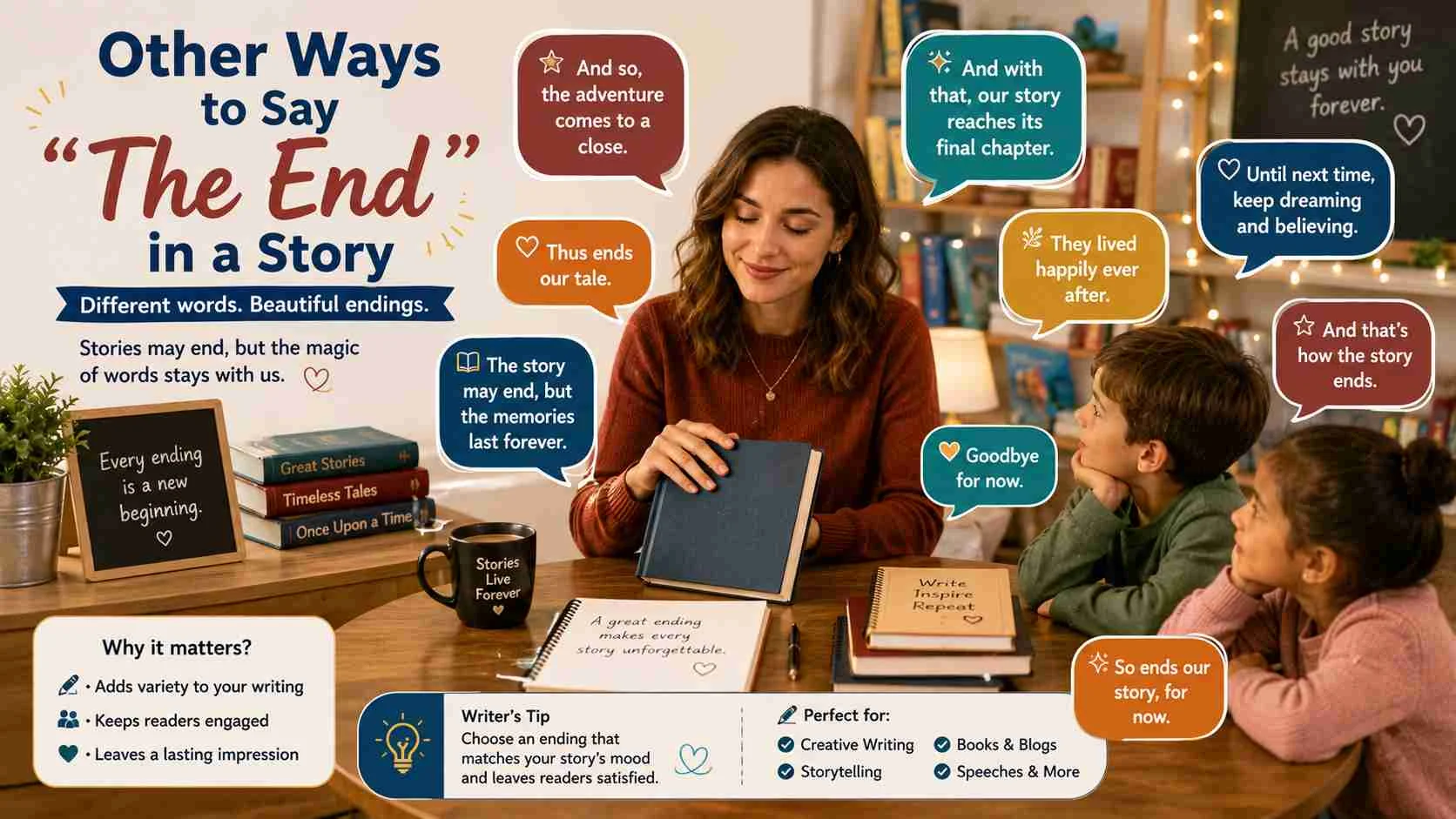
If you want alternatives to “the end” in a story, some of the best options include That’s all folks, The story concludes, Fin, And they lived happily ever after, and The curtain falls. These expressions help writers, students and professionals choose the right tone for fiction, storytelling, presentations and creative writing.
The phrase “the end” is traditionally used to signal that a story, narrative, film, or presentation has finished. It is short, clear, and universally understood.
People use it in books, short stories, movies, speeches, and even casual storytelling. However, repeating the same phrase can sound predictable or emotionally flat.
Learning other ways to say “the end” in a story helps English learners sound more natural and expressive. It also improves creative writing, storytelling flow, and the ability to express excitement in English with the right tone and emotion.
“A strong ending leaves a lasting impression on the reader.”
Formal Alternatives to “The End”
- The story concludes
- In conclusion
- This marks the end
- The narrative closes
Pro Tip
Use formal alternatives in essays, presentations, academic writing, or professional storytelling where a polished tone matters.
Casual Alternatives
- That’s all folks
- And that’s a wrap
- Game over
- That’s it
Pro Tip
Casual phrases work best in conversations, blogs, videos, and friendly storytelling situations.
Professional Alternatives
- This concludes the presentation
- Final remarks
- Closing statement
- End of report
Pro Tip
Professional reaction phrases should sound respectful, clear, and audience-friendly.
Informal Expressions
- Fin
- Curtain’s down
- Story over
- Boom, done
Pro Tip
Informal expressions in English are best for creative or humorous contexts, not formal writing.
“Choosing the right ending phrase changes the entire mood of your story.”
Common Mistakes When Using “The End”
1. Using it in formal business writing
Example: The end of this report.
Correct: This concludes the report.
2. Repeating it too often in creative writing
Example: Every story ends with The End.
3. Using overly casual endings in academic work
Example: That’s all folks in a university paper.
4. Choosing dramatic phrases for simple contexts
Example: The curtain falls for an email update.
5. Ignoring tone and audience
Example: Game over during a professional speech.
“Tone awareness is one of the fastest ways to sound fluent in English.”
What Does “The End” Mean?
“The end” is a phrase used to indicate that a story, event, presentation, or narrative has finished.
Grammatically, it functions as a noun phrase and often appears independently at the end of written or spoken content.
Example sentence: After the final chapter, the words “The End” appeared on the screen.
When to Use “The End”
Use the phrase in these contexts:
- Storytelling
- Children’s books
- Films and scripts
- Presentations
- Speeches
- Narratives
- Creative writing
Spoken vs Written
- Spoken: More expressive alternatives are common
- Written: Simple endings are often preferred
Formal vs Informal
- Formal: This concludes the discussion
- Informal: That’s a wrap
Is It Professional or Polite to Say “The End”?
“The end” is polite because it clearly signals completion. However, it is usually not considered professional in business or academic settings.
Business example:
This concludes today’s meeting and final recommendations.
Polite? ✔️ Yes
Professional? ❌ No (in most cases)
Pros and Cons of Using “The End”
Pros
- Simple and natural
- Friendly tone
- Common usage
- Easy to understand
Cons
- Too informal for work
- Overused
- Limited emotional range
- Not suitable for formal writing
“Professional English depends on matching words to context.”
Other Ways to Say “The End” in a Story With Examples
These alternatives will help you sound more fluent, confident, and natural in different situations.
Use them according to tone, context, and audience to express excitement, admiration, or approval.
1. Phrase | That’s All Folks
- Meaning: A humorous way to end something.
- Explanation: Common in cartoons and casual storytelling.
- Example Sentence: “That’s all folks” appeared after the animated episode.
- Best Use: Casual stories
- Worst Use: Formal reports
- Tone: Funny, light, informal
- Context Variability: casual / spoken / entertainment
2. Phrase | The Story Concludes
- Meaning: The narrative officially ends.
- Explanation: A polished and formal alternative.
- Example Sentence: The story concludes with a surprising twist.
- Best Use: Formal writing
- Worst Use: Casual jokes
- Tone: Professional, calm, polished
- Context Variability: professional / written / academic
3. Phrase | Fin
- Meaning: French word meaning “end.”
- Explanation: Often used in artistic or cinematic works.
- Example Sentence: The film faded out with the word “Fin.”
- Best Use: Artistic endings
- Worst Use: Business emails
- Tone: Elegant, creative, classic
- Context Variability: creative / cinematic / written
4. Phrase | And That’s a Wrap
- Meaning: Something is fully completed.
- Explanation: Frequently used in media and production.
- Example Sentence: After filming the last scene, the director shouted, “That’s a wrap!”
- Best Use: Media projects
- Worst Use: Academic essays
- Tone: Casual, energetic, upbeat
- Context Variability: spoken / entertainment / casual
5. Phrase | The Curtain Falls
- Meaning: The performance or story ends.
- Explanation: A dramatic and theatrical expression.
- Example Sentence: As the curtain falls, the audience applauds loudly.
- Best Use: Theater writing
- Worst Use: Emails
- Tone: Dramatic, elegant, emotional
- Context Variability: theatrical / literary / formal
6. Phrase | Story Over
- Meaning: The narrative has finished.
- Explanation: A direct and informal alternative.
- Example Sentence: The kids laughed when he said, “Story over.”
- Best Use: Casual speech
- Worst Use: Professional settings
- Tone: Informal, simple, relaxed
- Context Variability: spoken / casual / family
7. Phrase | This Marks the End
- Meaning: Indicates the conclusion of something.
- Explanation: Common in speeches and presentations.
- Example Sentence: This marks the end of our discussion today.
- Best Use: Presentations
- Worst Use: Humor writing
- Tone: Professional, respectful, formal
- Context Variability: business / spoken / formal
8. Phrase | Happily Ever After
- Meaning: A joyful ending to a story.
- Explanation: Often used in fairy tales.
- Example Sentence: The prince and princess lived happily ever after.
- Best Use: Fairy tales
- Worst Use: Serious reports
- Tone: Warm, magical, positive
- Context Variability: storytelling / children / literary
9. Phrase | Game Over
- Meaning: Something has completely ended.
- Explanation: Popular in gaming and modern speech.
- Example Sentence: Once the timer stopped, it was game over.
- Best Use: Gaming contexts
- Worst Use: Professional meetings
- Tone: Casual, modern, dramatic
- Context Variability: spoken / entertainment / informal
10. Phrase | End of Chapter
- Meaning: One part of a story is complete.
- Explanation: Can be literal or metaphorical.
- Example Sentence: Graduation marked the end of a chapter in her life.
- Best Use: Emotional writing
- Worst Use: Comedy scripts
- Tone: Reflective, meaningful, thoughtful
- Context Variability: literary / spoken / motivational
11. Phrase | This Concludes the Presentation
- Meaning: Official ending of a presentation.
- Explanation: Very common in professional English.
- Example Sentence: This concludes the presentation for today.
- Best Use: Business meetings
- Worst Use: Casual storytelling
- Tone: Professional, direct, formal
- Context Variability: professional / spoken / workplace
12. Phrase | The Narrative Ends
- Meaning: The storyline finishes.
- Explanation: Useful in literary analysis.
- Example Sentence: The narrative ends with unresolved tension.
- Best Use: Academic writing
- Worst Use: Informal chats
- Tone: Academic, formal, analytical
- Context Variability: educational / written / literary
13. Phrase | Closing Scene
- Meaning: Final part of a film or story.
- Explanation: Common in visual storytelling.
- Example Sentence: The closing scene left viewers emotional.
- Best Use: Film reviews
- Worst Use: Reports
- Tone: Cinematic, descriptive, emotional
- Context Variability: media / entertainment / creative
14. Phrase | Final Curtain
- Meaning: The ultimate ending.
- Explanation: Inspired by theater performances.
- Example Sentence: The actor took a bow after the final curtain.
- Best Use: Dramatic endings
- Worst Use: Technical writing
- Tone: Dramatic, theatrical, emotional
- Context Variability: artistic / literary / theater
15. Phrase | The Journey Ends Here
- Meaning: An experience reaches completion.
- Explanation: Emotional and reflective expression.
- Example Sentence: After years of struggle, the journey ends here.
- Best Use: Inspirational stories
- Worst Use: Quick updates
- Tone: Emotional, reflective, inspiring
- Context Variability: storytelling / motivational / spoken
16. Phrase | Conclusion Reached
- Meaning: The ending point has arrived.
- Explanation: Formal and analytical phrase.
- Example Sentence: After reviewing the evidence, a conclusion was reached.
- Best Use: Reports
- Worst Use: Fairy tales
- Tone: Formal, analytical, serious
- Context Variability: academic / business / formal
17. Phrase | The Tale Ends
- Meaning: The story finishes.
- Explanation: Literary and traditional wording.
- Example Sentence: The tale ends with a lesson about kindness.
- Best Use: Literature
- Worst Use: Emails
- Tone: Literary, classic, elegant
- Context Variability: written / storytelling / educational
18. Phrase | Over and Out
- Meaning: Communication is finished.
- Explanation: Borrowed from radio communication.
- Example Sentence: The host ended the podcast with “Over and out.”
- Best Use: Podcasts
- Worst Use: Formal essays
- Tone: Casual, playful, modern
- Context Variability: spoken / media / informal
19. Phrase | The Saga Comes to a Close
- Meaning: A long story reaches its end.
- Explanation: Best for epic narratives.
- Example Sentence: The fantasy saga comes to a close in the final book.
- Best Use: Long stories
- Worst Use: Short notices
- Tone: Epic, dramatic, literary
- Context Variability: storytelling / books / cinematic
20. Phrase | Final Remarks
- Meaning: Last comments before ending.
- Explanation: Common in professional speaking.
- Example Sentence: The CEO shared final remarks before the meeting ended.
- Best Use: Business settings
- Worst Use: Casual jokes
- Tone: Professional, respectful, formal
- Context Variability: workplace / spoken / professional
21. Phrase | The Adventure Ends
- Meaning: A journey or exciting story is complete.
- Explanation: Common in fiction and games.
- Example Sentence: The adventure ends as the heroes return home.
- Best Use: Fiction writing
- Worst Use: Academic reports
- Tone: Exciting, adventurous, emotional
- Context Variability: storytelling / gaming / literary
22. Phrase | End of the Road
- Meaning: The final stage has arrived.
- Explanation: Often used metaphorically.
- Example Sentence: After years of effort, they reached the end of the road.
- Best Use: Emotional stories
- Worst Use: Formal presentations
- Tone: Emotional, serious, reflective
- Context Variability: spoken / literary / motivational
23. Phrase | Mission Complete
- Meaning: A task has been successfully finished.
- Explanation: Common in gaming and action themes.
- Example Sentence: The agent smiled when the screen showed “Mission complete.”
- Best Use: Action stories
- Worst Use: Academic contexts
- Tone: Energetic, modern, confident
- Context Variability: gaming / entertainment / casual
24. Phrase | The Closing Words
- Meaning: Final spoken or written remarks.
- Explanation: Professional and polished phrase.
- Example Sentence: Her closing words inspired the audience.
- Best Use: Speeches
- Worst Use: Comedy writing
- Tone: Formal, respectful, polished
- Context Variability: presentations / business / formal
25. Phrase | It’s Finished
- Meaning: Something is complete.
- Explanation: Simple everyday expression.
- Example Sentence: After months of editing, the novel is finished.
- Best Use: Daily conversation
- Worst Use: Literary endings
- Tone: Neutral, simple, casual
- Context Variability: spoken / casual / general
26. Phrase | The Finale
- Meaning: The final and often exciting ending.
- Explanation: Common in performances and television.
- Example Sentence: The season finale shocked the audience.
- Best Use: TV and entertainment
- Worst Use: Formal emails
- Tone: Dramatic, exciting, energetic
- Context Variability: media / entertainment / spoken
27. Phrase | Last Scene
- Meaning: The final part of a dramatic work.
- Explanation: Used in film and theater discussions.
- Example Sentence: The last scene was unforgettable.
- Best Use: Film analysis
- Worst Use: Reports
- Tone: Cinematic, emotional, descriptive
- Context Variability: creative / entertainment / literary
28. Phrase | The Book Closes
- Meaning: The story or experience ends.
- Explanation: Symbolic and reflective phrase.
- Example Sentence: With that decision, the book closes on an important era.
- Best Use: Reflective writing
- Worst Use: Casual humor
- Tone: Thoughtful, elegant, literary
- Context Variability: written / motivational / storytelling
29. Phrase | End Transmission
- Meaning: Communication has ended.
- Explanation: Inspired by military and radio language.
- Example Sentence: The commander ended the message with “End transmission.”
- Best Use: Sci-fi stories
- Worst Use: Friendly emails
- Tone: Serious, technical, dramatic
- Context Variability: fiction / media / spoken
30. Phrase | The Conclusion Arrives
- Meaning: The final outcome appears.
- Explanation: A polished alternative for formal writing.
- Example Sentence: After many challenges, the conclusion arrives peacefully.
- Best Use: Formal storytelling
- Worst Use: Informal texting
- Tone: Formal, elegant, descriptive
- Context Variability: written / academic / literary
“Fluent English is not about difficult vocabulary. It is about choosing the right phrase for the right moment.”
Mini Quiz / Self Check
1. Which phrase is most professional?
A. Game over
B. That’s all folks
C. This concludes the presentation
D. Boom, done
Answer: C
2. Which expression works best in fairy tales?
A. Mission complete
B. Happily ever after
C. End transmission
D. Final remarks
Answer: B
3. Which phrase sounds most dramatic?
A. It’s finished
B. Final curtain
C. Story over
D. That’s it
Answer: B
4. Which option is best for business English?
A. Over and out
B. The closing words
C. Game over
D. Story over
Answer: B
Comparison Table | Top Alternatives
| Phrase | Tone | Best Use |
|---|---|---|
| The story concludes | Formal | Academic writing |
| That’s all folks | Funny | Cartoons |
| This concludes the presentation | Professional | Meetings |
| Happily ever after | Warm | Fairy tales |
| The curtain falls | Dramatic | Theater |
| Final remarks | Professional | Speeches |
| End of chapter | Reflective | Motivational writing |
| Mission complete | Energetic | Action stories |
| The finale | Exciting | Entertainment |
| Fin | Artistic | Films |
FAQs
What are the best alternatives to “the end” in a story?
Some strong alternatives include The story concludes, Fin, The curtain falls, and Happily ever after depending on tone and context.
Are there formal alternatives to “the end”?
Yes. Formal alternatives include This marks the end, Final remarks, and The narrative ends.
What is the most professional way to end a presentation?
The best professional reaction phrases are This concludes the presentation or Thank you for your attention.
Can I use informal expressions in English for storytelling?
Yes. Informal expressions in English such as That’s a wrap or Game over work well in casual or creative settings.
Why should I learn other ways to say “the end” in a story?
Learning alternatives improves fluency, creativity, tone awareness, and your ability to express excitement in English naturally.
Conclusion
Learning other ways to say “the end” in a story helps you communicate more naturally and confidently in English. Different situations require different tones, and choosing the right ending phrase makes your writing and speaking more engaging.
Practice these alternatives daily to improve fluency, creativity, and professional communication skills. The more you understand tone and context, the more natural your English will sound.