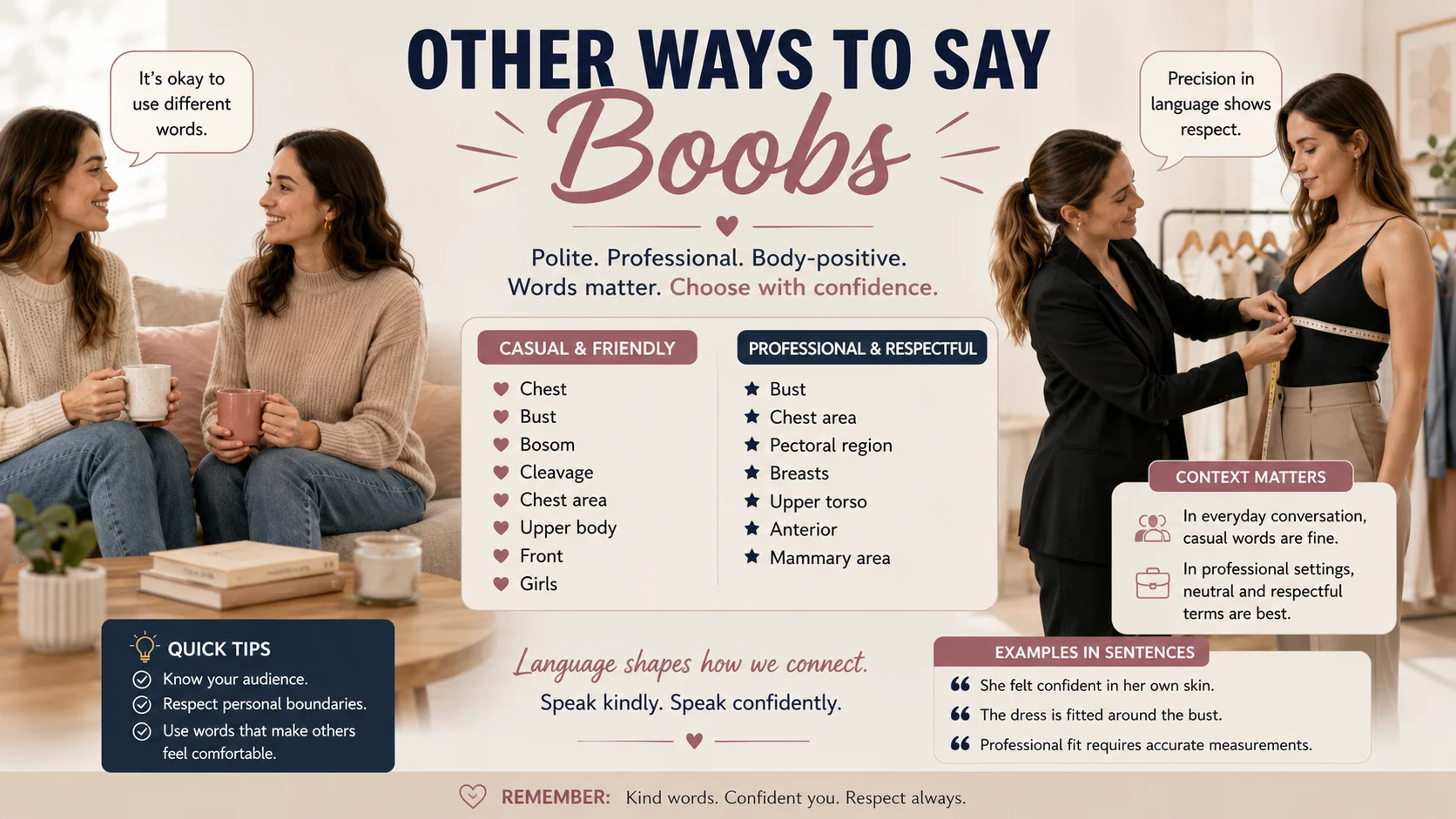
“Boobs” is a very informal English word for breasts. Common alternatives include breasts, chest, bust, bosom and cleavage. Learning different alternatives helps English learners choose the right tone in casual, medical, professional and polite conversations.
The word “boobs” is widely used in casual English conversations, pop culture, and online communication. However, it is highly informal and may sound inappropriate in professional or formal situations.
Learning other ways to say boobs improves your vocabulary and helps you communicate more naturally. It also helps you understand tone, context, and audience awareness in English.
You want polite alternatives to boobs, medical vocabulary, or informal expressions in English, this guide will help you sound more fluent and confident.
“The right word can make your English sound respectful, natural and professional.”
Formal Alternatives to “Boobs”
- Breasts
- Bust
- Bosom
- Chest
Pro Tip
Use formal alternatives in healthcare, education, or professional discussions to sound respectful and appropriate.
Casual Alternatives
- Boobs
- Tits
- Knockers
- Rack
Pro Tip
Casual expressions should only be used with close friends or in highly informal situations.
Professional Alternatives
- Breast tissue
- Chest area
- Upper body
- Bust line
Pro Tip
Professional reaction phrases and respectful vocabulary are essential in workplace communication.
Informal Expressions
- Chest
- Curves
- Cleavage
- Figure
Pro Tip
Some informal expressions are softer and more socially acceptable than slang terms.
“Fluent English is not only about vocabulary. It is about choosing the right tone.”
Common Mistakes When Using “Boobs”
1. Using it in professional settings
Example:
“I injured my boobs during exercise.”
Better: “I injured my chest during exercise.”
2. Using slang with strangers
Example:
“That joke about her boobs was rude.”
Informal slang can sound disrespectful.
3. Confusing medical and casual vocabulary
Example:
“The doctor checked my boobs.”
Better: “The doctor examined my breasts.”
4. Overusing slang in writing
Example:
“The article repeatedly used the word boobs.”
Formal writing usually avoids slang.
5. Ignoring tone and audience
Example:
“He used informal expressions in a business meeting.”
Always match your vocabulary to the situation.
What Does “Boobs” Mean?
“Boobs” is an informal plural noun used to refer to a woman’s breasts. The word is common in casual spoken English but is generally unsuitable for formal communication.
Example Sentence:
“She joked about buying a more comfortable sports bra for her boobs.”
When to Use “Boobs”
Use this expression carefully depending on context.
Common Contexts
- Casual conversations
- Comedy and entertainment
- Informal online communication
- Friendly joking situations
Spoken vs Written
- More common in spoken English
- Less appropriate in professional writing
Formal vs Informal
- Informal: ✔️
- Formal: ❌
“Tone awareness is one of the fastest ways to improve advanced English fluency.”
Is It Professional or Polite to Say “Boobs”?
The word “boobs” may sound casual or humorous, but it is not considered professional in most workplaces or formal environments.
Business-Style Example
Incorrect:
“The advertisement focuses on women’s boobs.”
Better:
“The advertisement focuses on women’s body image.”
Polite? ✔️ Yes, in casual settings
Professional? ❌ No, in most cases
Pros and Cons of Using “Boobs”
Pros
- Simple and natural
- Friendly tone
- Common usage
- Easy to understand
Cons
- Too informal for work
- Overused
- Limited emotional range
- Not suitable for formal writing
Other Ways to Say “Boobs” With Examples
These alternatives to boobs will help you sound more fluent, confident, and natural in different situations.
Use them according to tone, context, and audience to express excitement in English or communicate respectfully.
1. Phrase | Breasts
- Meaning: The standard formal and medical term.
- Explanation: Common in healthcare and professional English.
- Example Sentence: “The doctor examined her breasts carefully.”
- Best Use: Medical discussions
- Worst Use: Casual jokes
- Tone: Formal, respectful
- Context Variability: professional / medical / written
2. Phrase | Chest
- Meaning: The upper front body area.
- Explanation: A softer and more neutral alternative.
- Example Sentence: “She felt pain in her chest after exercise.”
- Best Use: Neutral speech
- Worst Use: Explicit humor
- Tone: Neutral, polite
- Context Variability: casual / professional / spoken
3. Phrase | Bust
- Meaning: A formal word for a woman’s chest measurement.
- Explanation: Often used in fashion and clothing.
- Example Sentence: “The dress fit perfectly around the bust.”
- Best Use: Fashion industry
- Worst Use: Casual slang
- Tone: Professional, elegant
- Context Variability: fashion / professional / written
4. Phrase | Bosom
- Meaning: A literary or old-fashioned word for breasts.
- Explanation: Often appears in novels and poetry.
- Example Sentence: “She held the child close to her bosom.”
- Best Use: Literary writing
- Worst Use: Modern slang
- Tone: Soft, poetic
- Context Variability: literary / emotional / written
5. Phrase | Cleavage
- Meaning: The visible space between breasts.
- Explanation: Common in fashion discussions.
- Example Sentence: “The dress showed noticeable cleavage.”
- Best Use: Fashion topics
- Worst Use: Formal meetings
- Tone: Descriptive, modern
- Context Variability: casual / fashion / spoken
“Professional English often depends on replacing slang with neutral vocabulary.”
6. Phrase | Bust Line
- Meaning: The chest measurement area.
- Explanation: Frequently used in tailoring.
- Example Sentence: “The jacket was tight around the bust line.”
- Best Use: Clothing design
- Worst Use: Humor
- Tone: Professional, technical
- Context Variability: fashion / professional / written
7. Phrase | Figure
- Meaning: A person’s body shape.
- Explanation: Indirect and softer expression.
- Example Sentence: “The outfit highlighted her figure.”
- Best Use: Compliments
- Worst Use: Medical contexts
- Tone: Polite, indirect
- Context Variability: casual / spoken / fashion
8. Phrase| Curves
- Meaning: Rounded body shape features.
- Explanation: Common in lifestyle conversations.
- Example Sentence: “The dress emphasized her curves.”
- Best Use: Fashion compliments
- Worst Use: Clinical discussions
- Tone: Friendly, positive
- Context Variability: casual / lifestyle / spoken
9. Phrase | Upper Body
- Meaning: The top section of the body.
- Explanation: Very neutral and broad.
- Example Sentence: “She injured her upper body during training.”
- Best Use: Fitness discussions
- Worst Use: Romantic contexts
- Tone: Neutral, professional
- Context Variability: fitness / professional / spoken
10. Phrase | Breast Area
- Meaning: The chest region.
- Explanation: Common in healthcare communication.
- Example Sentence: “The cream should be applied to the breast area.”
- Best Use: Medical instructions
- Worst Use: Casual jokes
- Tone: Clinical, respectful
- Context Variability: medical / professional / written
11. Phrase | Rack
- Meaning: Slang for breasts.
- Explanation: Very informal and potentially offensive.
- Example Sentence: “The movie used crude jokes about her rack.”
- Best Use: Slang humor
- Worst Use: Workplace speech
- Tone: Informal, crude
- Context Variability: slang / casual / spoken
12. Phrase | Knockers
- Meaning: Humorous slang term.
- Explanation: Usually used jokingly.
- Example Sentence: “That comedian used outdated jokes about knockers.”
- Best Use: Comedy
- Worst Use: Professional writing
- Tone: Humorous, informal
- Context Variability: slang / spoken / comedy
13. Phrase | Tits
- Meaning: Vulgar slang for breasts.
- Explanation: Common in highly informal speech.
- Example Sentence: “That language sounded disrespectful.”
- Best Use: Very informal talk
- Worst Use: Professional situations
- Tone: Vulgar, casual
- Context Variability: slang / spoken / entertainment
14. Phrase | Chest Area
- Meaning: Neutral body reference.
- Explanation: Appropriate for professional settings.
- Example Sentence: “The athlete experienced discomfort in the chest area.”
- Best Use: Professional discussions
- Worst Use: Romantic writing
- Tone: Neutral, respectful
- Context Variability: professional / medical / spoken
15. Phrase | Anatomy
- Meaning: The structure of the body.
- Explanation: Used in educational or scientific contexts.
- Example Sentence: “The course covered human anatomy.”
- Best Use: Education
- Worst Use: Casual slang
- Tone: Academic, formal
- Context Variability: educational / professional / written
16. Phrase | Breast Tissue
- Meaning: Medical reference to breast structure.
- Explanation: Common in healthcare terminology.
- Example Sentence: “The scan showed healthy breast tissue.”
- Best Use: Medical contexts
- Worst Use: Casual speech
- Tone: Clinical, technical
- Context Variability: medical / healthcare / written
17. Phrase | Front
- Meaning: Indirect reference to the chest.
- Explanation: Vague but sometimes useful.
- Example Sentence: “The shirt fit tightly around the front.”
- Best Use: Neutral comments
- Worst Use: Precision
- Tone: Soft, indirect
- Context Variability: casual / spoken / clothing
18. Phrase | Assets
- Meaning: Humorous compliment about appearance.
- Explanation: Can sound playful or inappropriate.
- Example Sentence: “The comment about her assets felt unprofessional.”
- Best Use: Informal humor
- Worst Use: Workplace speech
- Tone: Playful, suggestive
- Context Variability: casual / humor / spoken
19. Phrase | Endowment
- Meaning: Indirect humorous reference.
- Explanation: Often used jokingly.
- Example Sentence: “The article made comments about physical endowment.”
- Best Use: Humor writing
- Worst Use: Medical contexts
- Tone: Indirect, humorous
- Context Variability: comedy / casual / spoken
20. Phrase | Shape
- Meaning: General body form.
- Explanation: Softer and broader expression.
- Example Sentence: “The outfit complimented her shape.”
- Best Use: Fashion talk
- Worst Use: Medical precision
- Tone: Friendly, polite
- Context Variability: casual / fashion / spoken
21. Phrase | Contours
- Meaning: Body outline or curves.
- Explanation: Common in beauty and fashion writing.
- Example Sentence: “The dress followed the contours of her body.”
- Best Use: Style writing
- Worst Use: Informal jokes
- Tone: Elegant, descriptive
- Context Variability: fashion / written / spoken
22. Phrase | Form
- Meaning: Body appearance or structure.
- Explanation: More common in artistic descriptions.
- Example Sentence: “The sculpture celebrated the human form.”
- Best Use: Art discussions
- Worst Use: Casual slang
- Tone: Artistic, formal
- Context Variability: art / literary / written
23. Phrase | Physique
- Meaning: Overall body build.
- Explanation: Broad and respectful alternative.
- Example Sentence: “The athlete had a strong physique.”
- Best Use: Fitness contexts
- Worst Use: Specific references
- Tone: Professional, neutral
- Context Variability: fitness / professional / spoken
24. Phrase | Body Shape
- Meaning: Overall body structure.
- Explanation: Neutral and inclusive phrase.
- Example Sentence: “Different clothes suit different body shapes.”
- Best Use: Fashion advice
- Worst Use: Slang humor
- Tone: Neutral, friendly
- Context Variability: fashion / spoken / written
25. Phrase | Figure Line
- Meaning: Fashion-related body outline.
- Explanation: Often used in styling discussions.
- Example Sentence: “The design improved the figure line.”
- Best Use: Fashion reviews
- Worst Use: Casual joking
- Tone: Stylish, professional
- Context Variability: fashion / written / professional
26. Phrase | Curvy Figure
- Meaning: Rounded body appearance.
- Explanation: Positive and descriptive phrase.
- Example Sentence: “The brand celebrates every curvy figure.”
- Best Use: Lifestyle topics
- Worst Use: Medical writing
- Tone: Positive, casual
- Context Variability: lifestyle / fashion / spoken
27. Phrase | Silhouette
- Meaning: The outline of a body shape.
- Explanation: Common in fashion English.
- Example Sentence: “The dress created a flattering silhouette.”
- Best Use: Fashion writing
- Worst Use: Casual slang
- Tone: Elegant, refined
- Context Variability: fashion / written / spoken
28. Phrase | Frame
- Meaning: Body structure or build.
- Explanation: Broad and indirect reference.
- Example Sentence: “The jacket suited her frame well.”
- Best Use: Clothing advice
- Worst Use: Medical discussions
- Tone: Neutral, descriptive
- Context Variability: casual / fashion / spoken
29. Phrase | Torso
- Meaning: The main upper body section.
- Explanation: Anatomical and neutral term.
- Example Sentence: “The injury affected her torso.”
- Best Use: Anatomy discussions
- Worst Use: Romantic contexts
- Tone: Technical, formal
- Context Variability: educational / professional / spoken
30. Phrase | Body Contours
- Meaning: The curves and lines of the body.
- Explanation: Soft and descriptive phrase.
- Example Sentence: “The outfit highlighted her body contours.”
- Best Use: Fashion descriptions
- Worst Use: Medical precision
- Tone: Elegant, descriptive
- Context Variability: fashion / lifestyle / written
“Choosing the right alternative helps you sound fluent, respectful and culturally aware.”
Comparison Table | Top Alternatives
| Phrase | Tone | Best Use |
|---|---|---|
| Breasts | Formal | Medical discussions |
| Chest | Neutral | Everyday polite speech |
| Bust | Professional | Fashion industry |
| Bosom | Literary | Creative writing |
| Cleavage | Casual | Fashion conversations |
| Breast Tissue | Clinical | Healthcare |
| Upper Body | Neutral | Fitness discussions |
| Curves | Friendly | Lifestyle topics |
| Figure | Soft | Compliments |
| Physique | Professional | Sports and fitness |
Mini Quiz / Self-Check
1. Which phrase is most appropriate in a medical context?
A. Rack
B. Tits
C. Breasts
D. Knockers
Answer: C. Breasts
2. Which expression sounds most professional?
A. Bust line
B. Rack
C. Knockers
D. Boobs
Answer: A. Bust line
3. Which phrase is best for fashion discussions?
A. Cleavage
B. Anatomy
C. Torso
D. Frame
Answer: A. Cleavage
4. Which phrase is too informal for workplace communication?
A. Chest area
B. Breast tissue
C. Upper body
D. Tits
Answer: D. Tits
“Advanced English learners improve faster when they understand tone, not just vocabulary.”
FAQs
What are the most polite alternatives to boobs?
The most polite alternatives to boobs include “breasts,” “chest,” and “bust.” These phrases are more suitable for respectful or professional communication.
Is “boobs” a rude word in English?
“Boobs” is not always rude, but it is informal. It may sound inappropriate in workplaces, academic writing, or professional conversations.
What is the medical term for boobs?
The medical and anatomical term is “breasts.” Healthcare professionals commonly use this word in formal discussions.
Which alternatives to boobs are professional?
Professional alternatives include “breasts,” “chest area,” “breast tissue,” and “upper body.” These expressions work better in formal English.
Are slang words like “tits” and “rack” offensive?
They can sound vulgar or disrespectful depending on tone and context. English learners should avoid them in professional or unfamiliar settings.
Conclusion
Learning other ways to say boobs helps English learners communicate more naturally and confidently in different situations. Some expressions are formal and professional, while others are casual or slang-based.
Understanding tone awareness is essential for fluent communication. Practice these alternatives regularly so you can choose the right vocabulary for professional English, casual conversations, and everyday interactions.